
A brotherly leader
The West toyed with Gaddafi and broke our belief system. Maybe he can yet help us rebuild it.

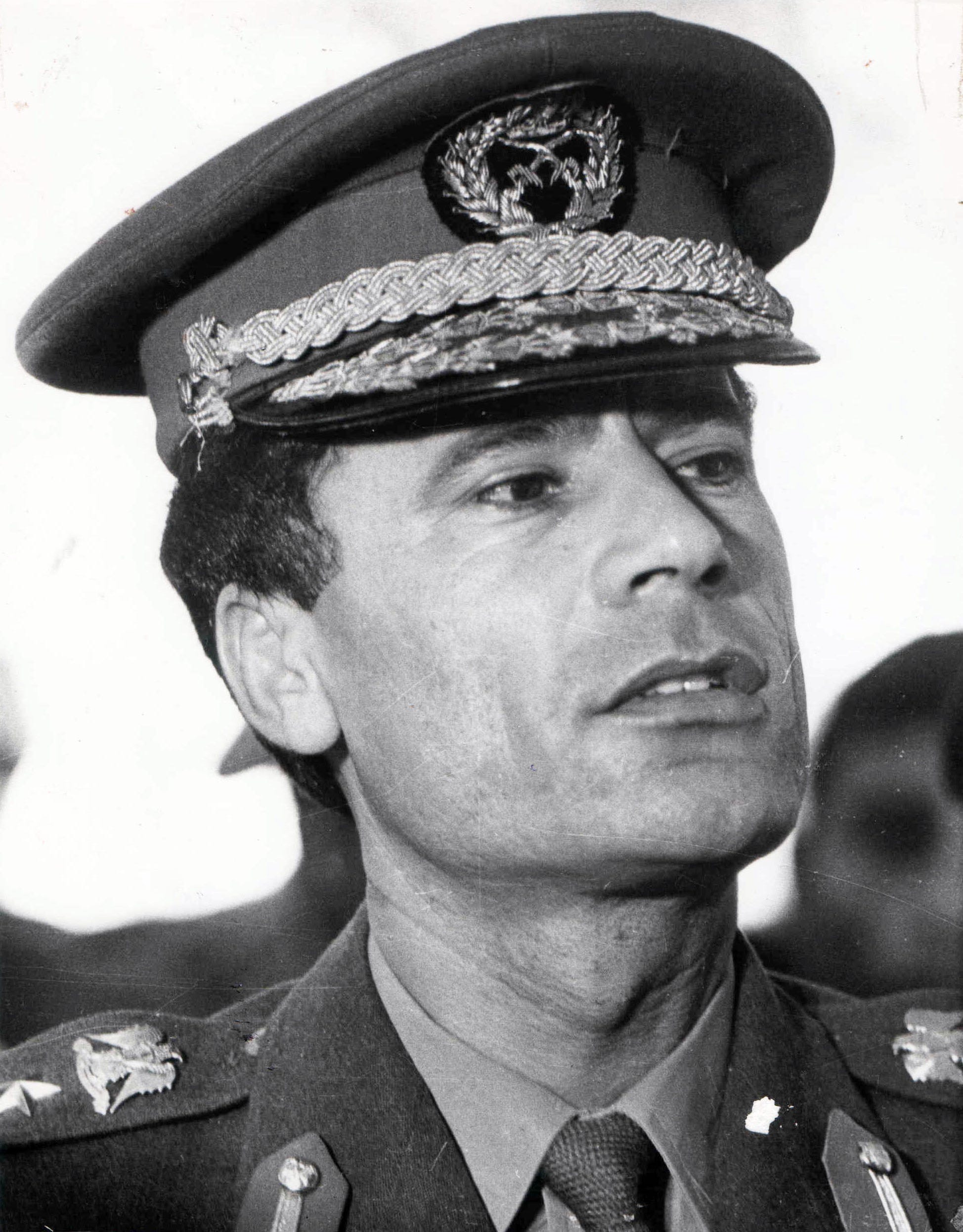
Image: Colonel Muammar Gaddafi in 1970, just after he assumed the role of Brotherly Leader of Libya.1
I don’t know if I should be writing this, but I’m going to anyway. I’m at a watershed moment in my life, and either you’ll be interested to read of my experience, or you’ll think it’s a crock of sh**, or you may just feel that what follows strikes a chord with you, because you too feel that your life has reached a watershed moment. Just to remind you, a watershed is a topographical divide at which water stops flowing in one direction, and starts flowing in the opposite direction. Nothing much changes in terms of the perceived landscape, but the streams and rivers all just start to flow the other way. Bear that in mind.
I am not Namibian, but this piece caught my eye. As did this piece:
On the assumption that these reports concerning Namibia and Burkina Faso are accurate, then the message is this: expunge the western influence, the western military forces, the western financial hegemony, and develop your own self-sufficient industry to feed and maintain yourself, and you can flourish. Cynically, we must ask: for how long? For how long before greed and avarice take over and usurp the utopia that you have thereby created? And the simplistic, if not the true, answer to that is: we must instil systems that will prevent greed and avarice from arising in such force as turns our societies topsy-turvy.
Sovereignty is the prerogative to act in one’s own best interests without being constrained by outside forces. The shirking-off of colonial-style debt makes a big difference to Namibia and Burkina Faso; and it has made a big difference to me. When, a couple of years ago, the price of energy sky-rocketed in Belgium, as elsewhere, a friend of mine contacted the electricity supplier to see what could be done. As it was reported by her to me, the response came back down the telephone line: Move house. Down-size, give up the home you built over decades, where your children grew up and your rose trees bloom, and go and live in a smaller dwelling that doesn’t use as much energy to heat it. It reminded me of the old truth about Rolls-Royce cars: if you need to ask what the running costs are, you can’t afford one.
It was a friend of mine in Brussels who got me into translation. He and I had been trainee lawyers at a firm in Stuttgart, and upon his return to his home town of Brussels, he’d secured work with one of the most renowned lawyers in Belgium, Pierre Van Ommeslaghe. My friend introduced me as a native English speaker with good legal background, who could refine and correct the firm’s English texts, and translate their French ones, and later their Dutch ones, into the requisite language. When the machines took over translation, the whole business model altered and work has been hard to find in recent years. I came to the conclusion that I too might simply have to sell my house in order to pay my way. The problem is that a third friend lives with me and not only pays me useful rent but relies on being able to stay in the house because of his work situation. So, I shelved my plans to sell my house, which left me in an awkward position regarding my company, which is haemorrhaging funds and whose liquidation would need me to have sold the house in order to pay a latent tax liability.
What I’m trying to say here is that my freedom of action—selling my home and liquidating my company—is constrained by the lodger, who enjoys no security of tenure but needs to be here for his work. There are two ways to view that: there is reality according to law; and there is reality according to my own perception of reality. Mine, and a fourth friend’s. The fourth friend is the key to the solution. Not the law.
The fourth friend has lent me a sizeable sum of money, which allows me to pay off the company’s debts by way of a cash injection. Her loan is enough to successfully liquidate the company, or to sell it to a willing buyer. She has provided me with more than just cash; she has given me air to breathe. I told her that I wasn’t sure when I could repay her, it would depend on when I sold the house, and that would depend on when the third friend no longer needed to be here. That is a lot of conditions, but she swept them away by saying that I didn’t need to make provision in my will for her, on the supposition that I could die, and in any case repayment in two, three years, whenever, was also good. I can’t describe the wave of relief that swept over me when she said that, knowing that I can trust in her and that she means every last word. She lives a comfortable, worry-free, but not extravagant existence, and the core issue is that she doesn’t at this time need the money she lent me. There are many legal holes in this arrangement: I could abscond, take a plane to Barbados and disappear, with her money, and leaving all my liabilities behind me. I could sell the house from under my third friend’s feet, and leave him homeless. I could disappoint everyone and still not break the law. But I won’t. Because this particular system, involving three related but legally unrelated parties only works if everyone is open, honest and willing to cooperate. It is solely our willingness to cooperate with each other that will allow our arrangement to work, and that includes my efforts to repay my fourth friend her money: that way she can lend it out to someone else (she has lent money to at least two other people that I know of). Each of the three of us in this constellation is no less sovereign for being within it, and yet remains constrained not by legal restrictions but by the restrictions we have adopted ourselves, willingly, in consideration of the help extended to us.
The three constituent elements of utopia are freedom, equality and brotherhood. And, if brotherhood is incapable of co-existing with freedom and equality, then one of the other two must be suppressed in order to assure the survival in some form of the three together. If the members of a society will not embrace each other with compassion and empathy (i.e. brotherhood), then their freedoms must be restricted until those sentiments resurface in order to create a sense of equality that allows freedom to be re-established. The crucial question is whether leaders should wait for brotherhood to dissipate and then squeeze freedom, or whether they should squeeze freedom in order to ensure that brotherhood does not dissipate in the first place.
One of the reasons why the Soviet Union fell apart is that the hopes and desires that were nurtured after the 1917 Revolution and would end up usurped by Stalin’s 1937 toy constitution and the gulags, gradually dissipated until, by the 1970s and 80s, there was no hope left. Soviet society latterly lived in a twilight zone, in which the authorities pretended that everything worked as it should, and the population pretended to believe them. It was Hungary that triggered the break-up of the Soviet Union. The Eastern Bloc system had become such a house of cards that one simple chink in the armour was enough to dispel the people’s belief in the whole pretence it had become, and bring the structure collapsing to the ground. Hungary opened its border to Austria in 1989 and East Germans, who could travel relatively freely within the Eastern Bloc, set off on holiday to Hungary that summer, and quietly slipped over the border into the West. The trickle of holidaymakers grew to a rush and, by the end of that year, East Germany had opened its border to the West as well. The play-acting of belief in the communist system had crumbled as, like a tidal wave, the populations of the Bloc’s countries woke up to reality, as if coming-to after an LSD trip that had lasted 40 years. The thing with an LSD trip is that, when you’re in it, you have nothing but love for all around you and everything is in perfect harmony. It is a wonderful state of being and, for as long as it lasts, it is indeed reality. The unfortunate thing is that you will rarely find an entire electorate who are all, to a man, woman and child, high on LSD. The reality that the sober must grapple with is the reality that politicians serve up to them. And that is even simpler than the reality one sees when on the high of an LSD trip; it has to be, because even the politicians cannot deal with real realities; so they make them up.
It’s strange to relate, but one of the greatest stool pigeons of the past 50 years of Middle East politics was Muammar Gaddafi (or al-Gathafi). He spent a short period in 1966 at a military academy in Beaconsfield, where Benjamin Disraeli had been the member of parliament, and had learned first hand the disdain that white, onward Christian soldiers were capable of doling out (he would describe it in his rudimentary English in a TV interview as ill-treatment, without going into further detail, apart from adding that the miscreants were Jewish). He came to the head of Libya via a bloodless military coup in 1969; he had an entrancing allure and was given to extensive philosophical thought on matters of democracy and economics, with his famed Third Universal Theory, which sought to advocate a political system that was neither capitalist nor communist.
Ronald Reagan, who became U.S. president in 1981, was bamboozled by the Syrian-backed Hizbullah suicide bombers who had wiped out 241 U.S. Marines in Beirut in 1983. Instead of trying to understand the forces and influences that had surrounded the slaughter by Christian militiamen of thousands of Muslims hemmed into their refugee camp by the Israeli army, Reagan had simply pulled his forces back out of Lebanon, and decided that he would instead look for a bogeyman to blame for his woes, and he found one. In the 1980s, when U.S. intelligence said they had proof of something, then no one questioned it. They had the most advanced intelligence services in the world: how could they not know?
They knew, for instance, that far from America being singled out for its meddlesome power-peddling in places where it was unwelcome, it was instead being thwarted by forces of badness in its God-given mission to spread democracy, freedom, human rights and all God’s goodness to the world. Evil. An axis of evil, even. They relied on the narrative of the eternal struggle between good and evil, which Hollywood had planted so firmly in the world’s minds with John Wayne’s westerns, Errol Flynn conquering Burma single-handedly, and the Wizard of Oz’s Wicked Witch of the West. The part of the goody was already allotted to Uncle Sam. But who would be the baddy in this fictionalised blockbuster? None other than our friend Muammar Gaddafi. Among Arab leaders, Gaddafi was as lonely and isolated as he had felt at the army school in Beaconsfield. His philosophies were laughed at, he was held in low regard internationally. He sought any means to prove his revolutionary credentials, and then the CIA gave him them, free, gratis and for nothing.
Just after Christmas 1985, suicide bombers—them again—took out 19 people—including five Americans—in self-detonations at the airports at Rome Fiumicino and in Vienna. Immediately, the Italian investigation identified the bombers as Syrian—them again, again. The CIA, however, was adamant that they had been Libyan, without producing anything more than circumstantial evidence, which they never in fact produced, beyond their pointed accusation. The bluffs were manyfold: the CIA knew that Gaddafi wasn’t a terrorist mastermind, but, with Reagan being goaded by his own parliament, the CIA goaded him into accusing Libya’s Colonel Gaddafi as the guilty party. Gaddafi in turn did nothing to disabuse the world of the accusations, because of the renown it brought him and the fear it instilled in his opponents. The only defence he put up in the end just ended up upping the ante: he explained the CIA’s accusations as being prompted by racism and the spirit of the mediaeval jaunts to Jerusalem, describing Ronald Reagan as a stinking, rotten crusader. He would go on to get Germans to try and build him a rocket (to explore outer space, you understand) and even procured the bits to build a nuclear reactor, except his technicians couldn’t understand how to put it together. He vowed to lend support to the Nation of Islam at their annual conference in Chicago, IL, promising to fund the raising of an army of Blacks in America to procure the rights that white Americans would not grant them without a struggle—an early iteration of Black Lives Matter; he gave funds to the Irish Republican Army in Northern Ireland as well, and even had the temerity to call Margaret Thatcher a harlot. Which I don’t think she was. She was many things, but I don’t really think she was a harlot. However, the curve ball that so deftly avoided accusing al-Assad in Damascus for the Rome/Vienna bombings was not the product of mistaken identity but of design, and the image of a madman who wanted to rule the world, virtually inspired by the films of James Bond, was bizarrely taken up by Gaddafi for all it was worth in television exposure and enigmatic smiles.
It suddenly seemed as if Gaddafi was the default accused for all and any terrorist attacks around the world. Intelligence services listened to speeches by Gaddafi, which fed on the false accusations previously made against him, to then conclude in his guilt for later atrocities for which he’d been as innocent as those that led to said speeches. Gaddafi was a self-perpetuating fantasist, whose fantasies were fed by the CIA, and whose utterances as a product of those fantasies were taken as proof of his complicity and guilt. This process served two purposes: it gave Gaddafi the notoriety he sought, and it gave the CIA a reduced workload. It is perhaps ironic that the kind of public statements that were deemed to constitute proof of Gaddafi’s criminal mind were relatively tame when compared to Donald Trump’s public statements about the Iran War. How times have changed! With Syria’s Soviet and Arab support, the Americans decided to leave that sleeping and dangerous dog lying and instead to attack Libya. They did so in 1986, for no better reason than that it was somewhere to attack, and someone to blame, and in order to show that, by pummelling an innocent country, it was fulfilling its divinely anointed role as a bringer of peace.
It was the usual attempted decapitation—they attacked Gaddafi’s own house, and killed a number of its occupants, but not the dreaded Colonel himself. This turned out to be fortunate, because, when Pan-Am flight 103 was downed over Lockerbie in 1988, an act that investigators likewise attributed to Syria, Colonel Gaddafi was still to the fore to take the blame. In 1986, the U.S. had laid sanctions against Libya, and, in exchange for accepting liability for the downing of the Pan-Am airliner, the sanctions were lifted. A bizarre quid pro quo for a bizarre man. But a lifted sanction is a lifted sanction, after all, is it not? Regardless of how it gets lifted.
In the aftermath of the disastrous invasion of Iraq in 2003, which had been based on untruths spoken by certain international statesmen, a further bizarre unreality unfolded with an interruption to scheduled programming on the BBC whilst Tony Blair announced to the nation, not the death of the Queen as one might have suspected from the dramatic means deployed, but an admission by Colonel Gaddafi that he had weapons of mass destruction and he’d agreed to give them up and destroy them. They actually amounted to a half dozen barrels of mustard gas, which were lying around in a leaky basement somewhere, but the press and politicians the world over bought this story hook, line and sinker, and Gaddafi became rehabilitated as a global hero. Yes, he … enjoyed it. He gave a speech (90 minutes long) to the United Nations in 2009 and was celebrated in poetry and song. He became the living proof that the debacle in Iraq could at least show some smidgen of success, even if it was two thousand miles away in Tripoli. Hook, line and sinker—and nobody smelled anything fishy.
By the time of the Arab Spring in 2011, Gaddafi had fulfilled his purpose and was bombed by an American drone as he fled the capital, Tripoli. He died in a drain by the side of the road he’d been fleeing down, unsung, unremembered. His death was rejoiced at by the western countries that had celebrated him at the United Nations just two years previously.
These deceptions may have played Muammar Gaddafi like a marionette, and he may indeed have dreamed of one day becoming a world leader like Pinocchio, but the noses of the Americans and of the Libyan were equally long in this misrepresentation of reality to the world’s peoples and press. Nowadays, they shan’t be so easily deluded. Or shall they?
What has happened in the interim is not just that people have become wise to when they’re being led up the garden path—though without proper investigative journalists, how would they ever know?—it’s that the shadow dancing that constitutes today’s politics comprises precisely never revealing entirely what it is that constitutes reality or unreality. We hear so many lies from our leaders that we think we can deem everything they say an untruth. But those who play the stock markets are well tuned to what is true and what is an exaggeration. It’s like steganography—the art of concealing coded images within another image (in much the same way as written messages can be encoded within other written messages): in a world full of lies you always need to have something that you can rely on, a flag that marks the true angle of perception. The savants are privy to the key that unlocks the truth. The unsuspecting are left to wallow in uncertainty. It is the utter ostensible unreliability of all and any information that makes the suckers latch onto any titbit of information that they can categorically classify as true. Eureka! you can almost hear the cry. Or is that rather: Wolf!?
I feel a certain sympathy for Muammar Gaddafi. I think his United Nations speech made some very valid points (like pandemics that feed the profits of vaccine-makers). He may have suffered under some personality disorder, though I’m not in any position whatsoever to affirm that or state what any such disorder might have been. Put it this way, I don’t think his public statements were simply bravado and strutting. He believed in his own sovereignty, and yet was played like a fool his entire life long, by perfidious forces outside his country. The country he was trying to flee from crumbled in chaos upon his death; from a rogue state there emerged a failed state, and the West issued jubilant cries of ecstasy, but then did nothing to mend the disaster they so welcomed.
In short, we knew well before the Iran War that America sees the world in Black and white, in good and bad, in rich and poor, in force and victim, in cowboy and Indian, in coloniser and colonised. Its conduct of the Iran conflict is simply one more instance in which it parades on the world stage an unreality that by now has paled, which no longer persuades, and yet which the audience is powerless to substitute with a better show, with more convincing actors. And that comes because we have not yet been able to fully draw our attention away from the protagonists we have always traditionally associated with good. When we emerge from a theatre, we rave about what a great play it was, even though we know full well that the actors were simply putting it on. We cannot wrench ourselves out of our belief mindset. And, if the Iran War continues as it has proceeded up to this point, then we will need to do some serious navel-gazing, to reconsider what is real, and where our truths now lie, once the world has turned us on our heads.
With Gaddafi, we were never sure, and he did nothing to help us decide. But in Iran, it’s time we learned more about this supposed enemy of the West. Because the enemy is slowly proving itself not to be there, but within.
We need brotherly leaders.
In case you missed it:
By Stevan Kragujević - Transferred from sr.wikipedia to Commons., CC BY-SA 3.0, https://commons.wikimedia.org/w/index.php?curid=70786070.
Hi Graham, great article. I understand that one of the big reason he was taken out is that he was stockpiling gold and he wanted Libya off the American Dollar Standard and he was also trying to get other countries to do the same, so they took him out. Do you know if that is true?