A Glasgow street song
Sunday musical excursion #51

This Sunday’s musical excursion takes you to Glasgow (Glesca), the city of my birth, and to an album of songs that I didn’t know existed until I was at university in our capital city of Edinburgh (Embra) and rifling through the record collection of a fellow law student. I just had to record it and, somewhere on my system is that tape recording. I’m overjoyed to see someone has been mindful enough to put it up on YouTube, so it’s a somewhat scratchy LP recording that you have here and, below, you have my favourite song from the collection, which I sing to myself every time I make a cooked breakfast.
Glasgow Street Songs is an album by evergreen Scots folk singers Robin Hall, who sadly departed this world in 1998, and Jimmie Macgregor, who is still to the fore, age 95. They immortalised Scottish folk song together in a partnership that lasted 20 years.
The cover to the album is utterly emblematic of post-war Glasgow, with its bombed-out gap sites, its ambitious urban redevelopment programmes, its tenement (Victorian sandstone apartment-block) clean-ups (outside to remove soot of ages past, and inside to remove today’s dry rot), and a heart and soul that was rooted in guts, in the form of Red Clydeside’s socialism and letting the kids explore their urban environment such as they found it.
The embedded starting point is the beginning of the song whose lyric you can find below, but take the opportunity to explore the rest of the record: weep at loves lost, spit at cheeky gallus lads who take advantage of a coy little lassie; hear about the three (and only three) crows that once sat upon a wall on a cold and frosty morning, and take warning: you can’t shove your grannie off a bus.
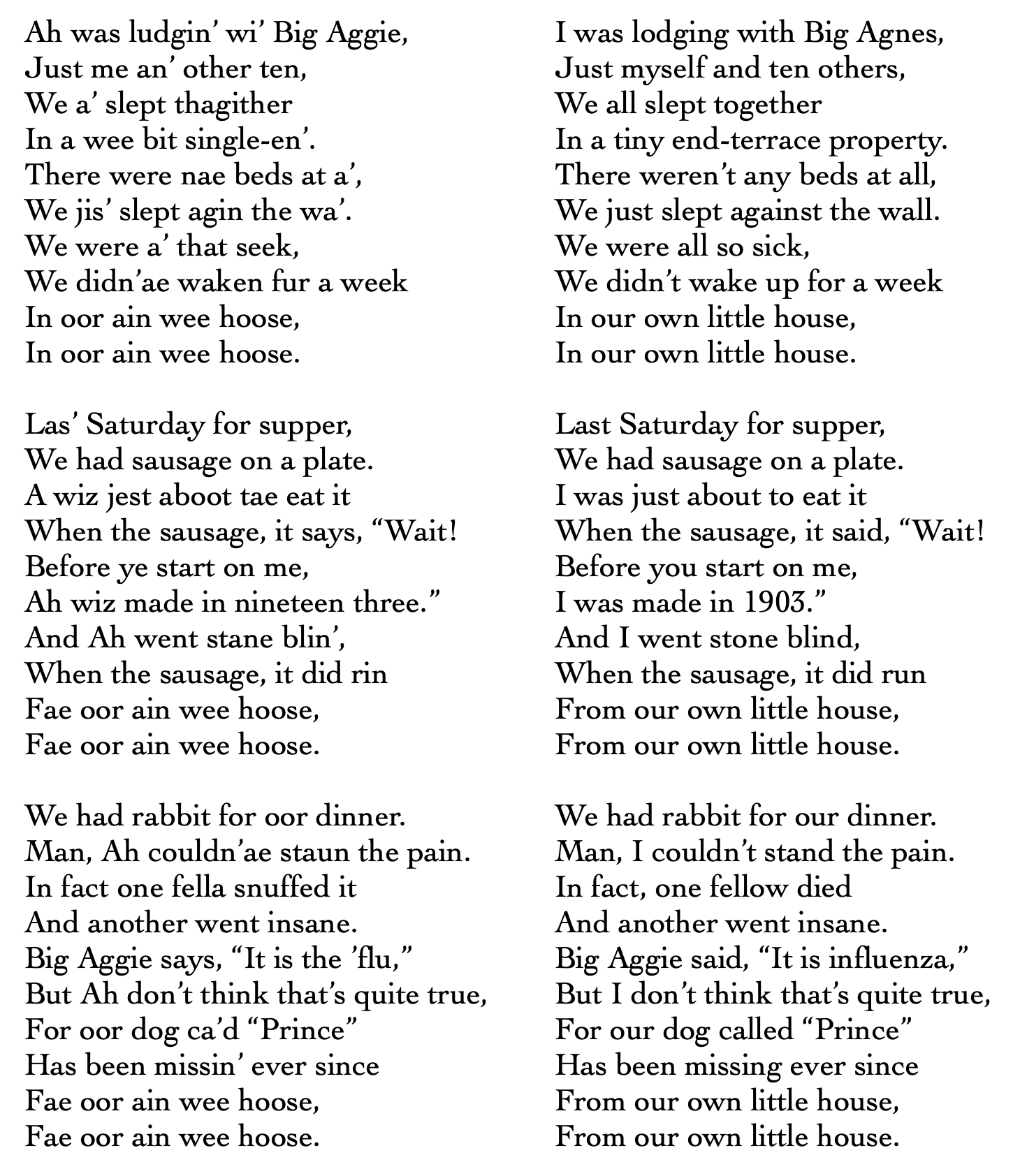
Ludgin’ Wi’ Big Aggie is about a lodging house, probably in the East End or Gorbals area of the city, run by a seemingly fearsome battleaxe of a figure named Big Aggie (or Agnes). In the worst traditions of cheap lodging houses, the beds are not quite up to the usual standard, even if they are up against the wall, and the food would leave much to be desired, if it would only stick around long enough to be left. The landlady’s lame excuses are proved to be suspect when it turns out the household’s pet has mysteriously vanished.
These conditions are probably exaggerated. But only slightly. Poverty has been, and, it seems, will be again, the blight of many a post-industrial city, and Glasgow is emblematic of that malaise as well.
You can see the song on two levels. As an idealistic, but tongue-in-cheek, elegy to every man and woman’s dream: to have a wee house of their own; but tinged with the realities of what that means for those who are destitute, without a hope of ever rising above their bootstraps. Or as a lament (that is the music’s style), asking, “Need it truly be so? Need it truly be?”
This is a journey back in time to a city with a proud history and an unbeatable, beating heart. I’ve provided an English translation for those unfamiliar wi’ Glesca’s funicular. Enjoy your cooked breakfasts this Sunday morning.
Ludgin’ Wi’ Big Aggie
Traditional
Performed by Robin Hall
From Robin Hall and Jimmie Macgregor’s 1970 album Glasgow Street Songs