
An envy-driven debate
Do you envy the rich, or do you fear the envy of the poor?

A travelling man knocks at the door of a well-to-do town villa and, upon the door being opened, enquires of the lady of the house whether there are any odd jobs that she requires doing around the property.
“What are you good at?” she asks.
“I can do gardening, window washing, painting—”
“Painting?” she interjects. “Listen, if you’re serious, go into the garage and you’ll find brushes and a pot of paint. I was going to paint the porch, but, since you’re here, you can do it if you like.”
“That I will, missus” the chap replies enthusiastically. And off he trots into the garage and finds the requisites the lady has spoken of.
Presently, the man knocks again at the front door of the house, and tells the lady that he’s finished and maybe she’d like to remunerate him for his work.
“Here you are—fifty pounds, is that all right?”
“That’ll do just dandy!” says he, adding, “By the way, you should know, it’s not a Porch. It’s a Mercedes.”
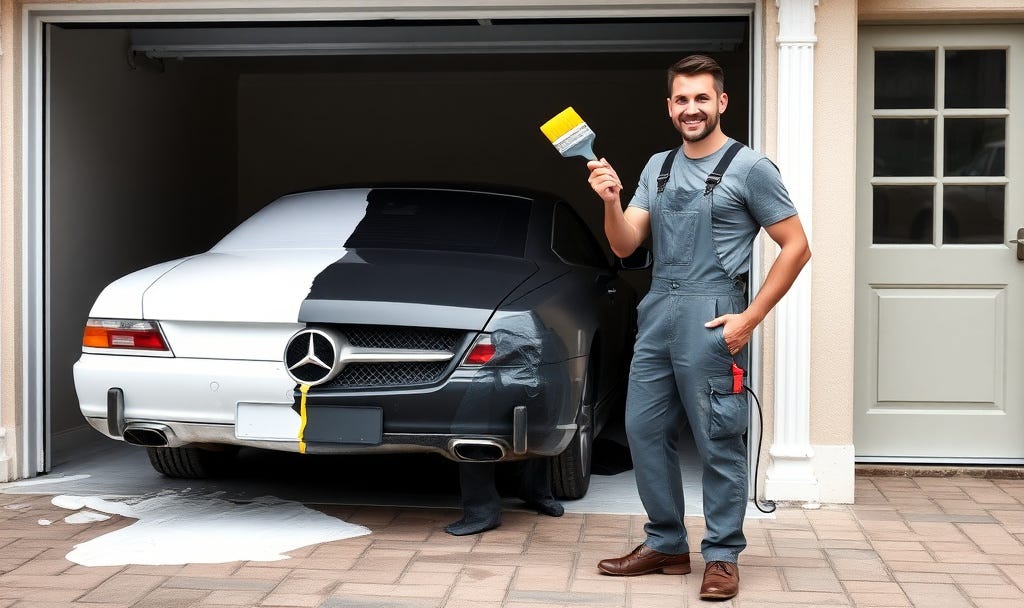
The chances of such a mistake—and my apologies if this is the millionth time you’ve heard the tale—being made at the town villa of the current owner of the Porsche motor company, Mr Wolfgang Porsche, is very slim. For a start, travelling men wanting to knock at his door would need to mount the 100 steps of the Salzburger Kapuzinerberg before even reaching his knocker (it’s the mound that sits to the east of the town on the opposite side of the Salzach from the Nonnberg Abbey, which featured in The Sound of Music) and, once there, there would be no car to paint anyway, since cars can’t access Mr Porsche’s house. That might strike you as an oxymoron: the heir to a motor car magnate living in a house that has no car access, but now comes the trick: Mr Porsche applied to the Salzburg city fathers for permission to build a tunnel through the Kapuzinerberg connecting his abode to a public car park at the foot of the mount.
Now, it doesn’t take that much to incense a Salzburger, but this plan made a goodly portion of them livid, and Mr Porsche has now come up with a solution. Withdrawal of the permission granted to him to bore the tunnel? No, not quite. That permission still has till November 2028 to run. His solution is simpler still: to sell the house.
The brouhaha has all come about because of a former resident of the property: the writer Stefan Zweig (whose name adorns the pathway that leads up to the house). Zweig loved the house precisely because no car can reach it. All of which is very interesting until you get to Porsche’s reaction to the uproar. It is, says his real estate manager, an envy-driven debate.
And it is that statement I’d like to dwell on. Because it is not envy-driven in the slightest.
Supremacists, generally, live in a dreamlike world in which they are convinced beyond any shadow of a doubt that all the 99.9 per cent, or however many we are who make up the masses, want is nothing more than to take their money from them. We covet their wealth and status and position and power. We too want what they’ve got, and we’re so pathetic because we just don’t want to work for it. We envy them. And no amount of telling them otherwise will disabuse them of that view.
It is a view that is shared by many Jews, especially in Israel. Jews have known unparalleled success in virtually every walk of life (certainly if you compare the level of their success to the proportion of the relevant populations that they represent). They are great actors and film directors, industrialists, bankers, writers, academics, Nobel laureates, and so on. They work hard, and achieve, and thereby acquire a conviction that gentiles, whom they sometimes refer to as goyim, are envious of them. And the belief that those who do not occupy the position that a given individual himself occupies covet that position out of envy is a manifest avowal of quite the opposite: it is an avowal of the fact that the person who occupies the position would himself be envious of anyone else who happened to occupy it. William Shakespeare put it thus in his play Hamlet: “The lady doth protest too much, methinks.”
In other words, envy is a character failing that is always, without fail, projected by the envied person onto those who purportedly do the envying. And, what is more, such an attitude betrays a sense by the powerful of supremacy over all those who putatively envy them. By stating that the local action taken to oppose Wolfgang Porsche’s private tunnel under the Kapuzinerberg is an “envy-based debate” is to utterly discount the arguments raised against the man and dismiss them out of hand by dint of the man’s supremacy. He who reigns supreme need not stoop to considering the arguments and rationales of mere underlings.
There is a widely held belief among the 99.9 per cent of the masses (and if there isn’t, then there is in me) that the position of the upper set is that they are supreme, they hold wealth in such abundance that it constitutes a lever of power in and of itself, without even having to purchase influence, and that it is not the place or position of the masses to question how they acquired their wealth, how they have secreted it in order to avoid paying their due tax liabilities, to question the influence they are able to bring to bear on bodies (such as city councils), or to otherwise call into question the private and professional actions they undertake in terms of their social lives, business lives or any other aspect of who they are. They are rich, and how they got rich is no concern of ours.
This lack of tangible connection between wealth and how it is acquired is intended to dissimulate the influence that it allows them to bring to bear. How are we rich? Never you mind! We are rich, and that is that. In a way, it doesn’t concern me whether a supremacist who throws his weight around earned every last farthing of his wealth through hard work and grind. What concerns me more is them throwing their weight around at all. But when the wealth with which that weight is thrown around is palpably ill-gotten, whether through criminal acts, or through shady dealings, or tax-dodging, or the purchasing of influence, or the peddling of favours, the resentment of throwing around the supremacist’s weight is no less, and—just possibly—much greater.
I do not envy the rich. I don’t envy their influence, either. To a large extent the fact that there are rich people doesn’t directly affect me in the slightest. Indirectly, yes, but in many-fold minuscule ways. Maybe in many-fold major ways, but which exactly they are I cannot tell. Not point to and identify. In short, whether or not Wolfgang Porsche bores a tunnel under his house to park his car doesn’t on the surface affect me one whit. And yet it does at a deeper level, because it will be one more instance of a man of wealth getting his way because he says so, rather than because it is just. And that does affect me directly. I resent anyone exercising their power in such a way as to denigrate others, simply because it opens the path to them using it to denigrate me. And what Wolfgang Porsche has done in Salzburg is to denigrate the burghers of that city.
From gay rights, to feminist rights to the right to clean water and clean air, and the right to walk down the street without being accosted for one’s clothes, or the colour of one’s skin, or one’s religion or one’s football club, and all the other rights that cloud the issues and relations between us as a society—these are all of naught beside the disdain in which the upper crust holds us all, every man jack of us, even those who believe they have inveigled themselves onto the elite’s good side, for the favour will only last as long as you are of utility to their ends.
If we could concentrate our efforts on righting the imbalance between the wages of the masses and the wages of the elites, first, that would not be done out of any sense of envy, but rather out of a sense of justice. It is simply unconscionable that a single individual should have hundreds of thousands at their free disposal. I say that not out of envy, but out of sheer mathematical incredulity. If one were to even out the tax burdens, the elites would have zero further ground on which to fear the envy of the masses. But, second, so palpable would be the flood of relief when the elites started to contribute in due proportion along with us all to the pot that is our tax revenue, that all the other quibbles between us would melt away to nothing, like the morning dew on a primrose.
When the nation goes to war, it unites behind one slogan: to defeat the enemy. All differences between the people are laid aside: they roll up their sleeves and they set to, to join in battle. That’s all they need to do. Link arms and join in battle: the battle for fair taxation. If anyone wants to stop Porsche building his tunnel after that, then that really is an envy-driven debate.
That’s it in a nutshell!!