
Freedom of expression
A philologist’s medal and an Austrian hotel’s photographs: do we know we know?

My eye was caught by a certain story in the newspaper this morning about a Frenchman called Florent Montaclair. The headline is “French professor accused of ‘gigantic hoax’ after inventing Nobel-style prize”. Although my mind turned momentarily upon reading that to the phony peace prize presented by FIFA to you-know-who, what really drew me in was the fact that this prize had been awarded to Mr Montaclair for his work in the field of philology. And that is a field I am familiar with, even if the article dismisses it as “particularly little known”.
I used to be a paid-up member of the Chambre belge des traducteurs, interprètes et philologues until, at one annual general meeting of its members, it resolved to change its name by omitting the reference to philologists. There aren’t any philologists these days, the argument ran, and any that there are, are not members of our association. And with that philology was deemed by what is now the Belgian Chamber of Translators and Interpreters to belong to the dim, dusty past of ancient language studies. How wrong they were, because Mr Montaclair holds the 2016 Gold Medal of Philology. And the fact that he awarded it to himself has caused a bit of a furore, one that has the services de la police nationale on his tail.
Y’see, to cut to the chase, Mr Montaclair ordered a gold medal from an online jewellery store in Delaware, paying $250 for it, and then proceeded with pomp and circumstance to award it to himself for his inimitable work in said field of linguistic studies. And then came the awkward bit: he professed his ownership of the medal, and of the skills by dint of which it was supposedly awarded to him, to secure certain benefits from the French State and his entourage. And now he’s been accused of forgery, and “use of forgery”, which is a French crime for what I know as “uttering”: you forge something, and then you contend vis-à-vis third parties that it is the real McCoy.
Mr Montaclair, just to clear up that charge against him, alleges that you can’t forge something that never existed, and that is a moot point. If I were to type the following text, would that be a forgery?
Birth certificate of Graham Vincent, issued in Belgium on 7 May 2026
Graham Vincent was born this day in Belgium.
Signed by the Mayor.
Probably not. But, if I put it in a fancy engraved border, and add some official looking stamps and a squiggly signature, perhaps. Maybe add a few details like the place and time of birth, parents and so on. The question then is at what point does a patently toy document become a forgery? Added to which is a further test: Does whether a document is regarded as a forgery or not depend on the document, the document’s owner, or the person to whom the document is presented?
I have a medal of my own. Here it is:
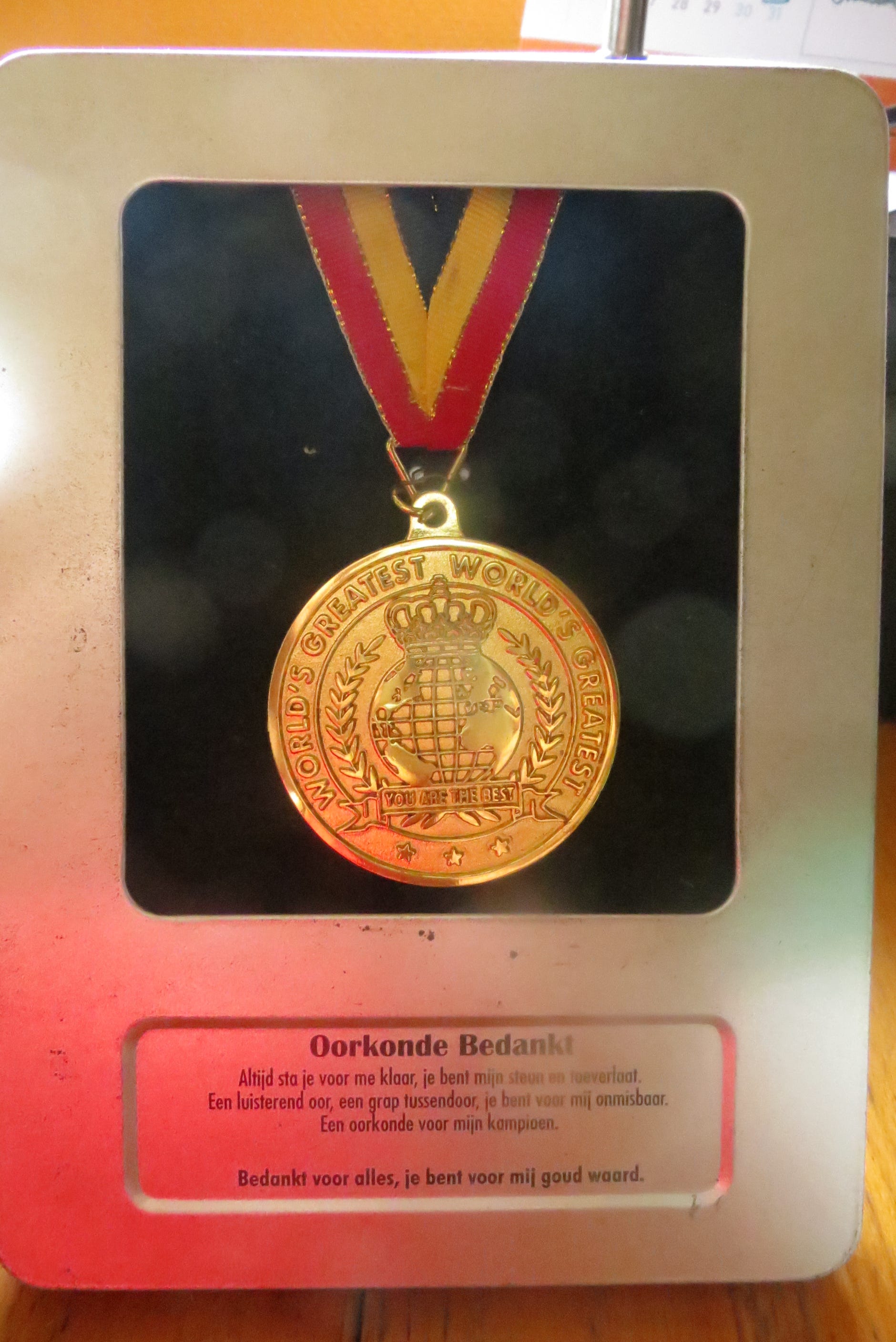
It is inscribed with the words World’s Greatest - You Are The Best, and, underneath, is a Dutch text which translates as Award of Thanks - You are always there for me, you are my support and reliance, a listening ear, ready with a joke, I could not do without you. An award for my champion. Thank you for everything, you are gold’s worth to me.
Well, there you are. In a nice little frame, with the colours of the Belgian flag as a ribbon. And you, dear reader, are the first person I ever mentioned it to. I didn’t buy it, it was given to me, by someone who is no longer in my life, but they were when I received it, so I presume they meant it at the time. Nowadays they can do without me. You could regard it as a credential, which is evidence of who I am that might engender belief in me, like the documents that ambassadors present to heads of state in the country where they are posted. Or letters of recommendation from an ex-employer intended to ease the employee’s way into new employment. Sort of, I believe in this person, and therefore so should you.
Careful employers do background checks on people these days. I remember the scandal of Karl-Theodor zu Guttenberg in Germany. He was a high-ranking politician and businessman who was discovered to have copied large portions of his doctorate thesis and ultimately had his doctor’s degree revoked by the University of Bayreuth, whereupon he resigned from the German government. He had not been who he had professed himself to be. He was a fraud. Eight years later, he was awarded a real doctorate, for which he had actually worked, by the University of Southampton, and he has since worked in high finance and thought leadership. His disgrace came less from having cheated, and more from maintaining for a long time that he hadn’t. But when the police knocked on Mr Montaclair’s door and asked whether he knew why they were there, he readily answered, “I assume it’s about the medal.” Vive la différence.
Niemand hat die Absicht, eine Mauer zu errichten. Walter Ulbricht, Chairman of the State Council of the German Democratic Republic with his public statement on 15 June 1961: No one has the intention of building a wall. On 13 August that year, the German Democratic Republic made a start on … building a wall; the Berlin Wall. Now, it’s unlikely whether West Germany and the western occupying powers could have done much to prevent East Germany from building its wall, but Ulbricht has nonetheless gone down in history as one of its greatest barefaced liars. A fraud. Just like zu Guttenberg, and just like Monsieur Montaclair, and, in the end, just like me. I am not the World’s Greatest, and I am no longer gold’s worth to the person who presented me with my medal. But, then it doesn’t figure on my CV. And I bet the barefaced lies of Tony Blair as he led the United Kingdom into a war with Iraq aren’t on his CV either. They don’t really need to be, because everyone knows that he lied. Of that there is no question. Everyone knows. The difference is not knowing whether he lied, but whether you care that he lied.
Donald Rumsfeld, the American foreign minister under Gerald Ford and George W. Bush, waxed lyrical at a press conference in 2002:
Reports that say that something hasn’t happened are always interesting to me, because, as we know, there are known knowns; there are things we know that we know. There are known unknowns. That is to say, there are things that we now know we don’t know. But there are also unknown unknowns. There are things we do not know we don’t know.
Rumsfeld’s remarks (which are not original, but his quotation of the posit enjoys notoriety) assume that a fact is something that is out there in the world just benignly waiting to be known and, up to that point, blissfully enjoying a status of being unknown. America was discovered in 1492, but America was there for aeons before 1492. After 1492—known. Before 1492—unknown. At least to those to whom it became known after 1492.
So, what do you now know about me on the basis of that medal? That I am the World’s Greatest? Or that someone thinks (or thought) that I am the World’s Greatest? And what act on your part might be provoked by your new knowledge about me being the World’s Greatest? Would you give me a job? Karl-Theodor zu Guttenberg has had a number of very lucrative jobs since 2011, and one can say that he got them despite him being a fraud. One might even be tempted to say he got them because he was a fraud, but I have no insight into that.
The medal that Montaclair awarded to himself doesn’t really exist, neither the institution that awarded it to him nor the title of the medal itself. He made it all up, and that is indicative of a riotous imagination (apparently, he writes vampire stories into the bargain). But people believed in his award, and thereby believed in him, and all of that procured certain benefits for him. Is he responsible for the belief that others placed in him on the basis of a fake award?
Donald Rumsfeld asserted in his autobiography that he had been opposed to the water-boarding torture carried out at Abu Ghraib prison in Iraq. He was the foreign minister at the time of the war crimes. So, how seriously should we take his opposition? Is the torture our fault for having believed he could stop it, the fault of the press for believing Mr Rumsfeld’s story? Or was the fault Mr Rumsfeld’s alone? For not stopping the torture, regardless of whether he was opposed to it or not?
Mr Montaclair is caught in a judicial dilemma: the medal he awarded himself does not exist, but medals such as the one he awarded to himself do. And the purpose of a medal is to manifest to the world one’s value and probity. The medal itself is the mark of honesty. So, technically, the people to which the medal is presented as a mark of worth should be able to place confidence in it and are absolved from any requirement to make further enquiry into the reasons for, the institutions making, and the portent of the award. A medal entitles us to take its value at face value. We are allowed to allow ourselves to be duped, because we have the power of the law at our hands to set things right when we find out that we have been. And that is a formula that only works with the little people.
It has to be said about Freiherr zu Guttenberg that, once he realised that his protests of doing nothing wrong became doomed to failure, he quit his job as Economy Minister in the government and went off to do a real doctorate thesis under his own efforts. Those were the times. Twenty eleven was only 15 years ago, but even then the brazen deceit, when called out, led to shame and withdrawal. Nowadays, they double down.
In another newspaper item from 2019, we have an extraordinary assertion of the right of expression of a Tyrolean hotel in Austria. A German couple and their family booked a stay at the hotel and were surprised to see two photographs decked in a floral arrangement on either side of the main door. The photos, it transpired, depicted the uncle and grandfather of the current owners of the hotel and—so they said—these were the only photos of those two individuals in the family’s possession. It is, it seems, normal practice in rural Austrian areas to erect this kind of public homage to deceased members of the family. I have a portrait in my office of my deceased mother. But she is not displayed publicly at the front door to my house. Unless one’s loss evokes an expression of grief so spontaneous and visceral that one does not care or is not concerned about what the public thinks of it, I find that the public (as opposed to private) display of a photograph of a deceased person is akin to erecting a public statue: who was this person, why should we remember them, and what message do they have to convey to us in the here and now from the distant past in which they lived? That sort of thing. What struck the German visitors to this idyllic country hotel was the way the two subjects were dressed: in the uniform of the Wehrmacht during the 1940s, complete with swastikas. That, according to the Germans, was an indication of why we should remember them.
Back home, the visitors wrote an evaluation of their hotel stay on TripAdvisor and Booking.com, in which they warned prospective patrons about the two photographs, and described one of the subjects as a Nazi grandpa. Now, you may be wondering whether it is all that bad to put up a photograph of a man in a wartime uniform complete with swastika in the lobby of your hotel, and regardless of what message you want to convey it is, after all, your hotel and, moreover, your grandpa. But, the hotelier was outraged that the patron had deigned to refer to his ancestor as a Nazi. Research revealed that the gent in question had indeed been a member of the National Socialist Party from 1941 to 1943, which the hotelier swore he had been unaware of. Still, he argued, before a court of law no less, that the patron had defamed him by stating publicly that the publicly displayed photo of his grandfather in his publicly accessible hotel was a picture of a Nazi.
I had a double take when I read that. The posit is that a man in a military uniform that depicts a swastika from the 1940s is not necessarily a Nazi, unless it be proved that he was in fact a member of the Nazi party. That would mean that it is defamatory to refer to the Nazis invading Poland, if, as one might suppose, some or all of the troops involved in that invasion were not paid-up members of the Nazi party. Or to imply that any act by the German nation during the years 1933 to 1945 involved Nazis, unless it be proved that they were members of that political movement. Perhaps de manière ludiquissime: there is no such thing as Nazi Germany, because not all Germans were members of the Nazi party.
The Austrian hotel story is illustrative of how wrong Donald Rumsfeld was. It has nothing to do with knowing what you know or don’t know and not knowing what you don’t know. It has to do with how people view what you say you know or don’t know, regardless of whether you actually know it or don’t know it, let alone whether you knew or didn’t know that you knew or didn’t know it. If you could follow Rumsfeld, you can follow that.
If you show me a medal that is such as you want me to know something about you, I’m entitled to assume I know what that is. But if you display a photograph of what is ostensibly a Nazi, I am unjustified in attributing to you a sympathy for Nazis unless I can prove that the subject of the photo is a member of the Nazi party. You can control what impression I gain of you through the photos that you publicly exhibit in your hotel, but I may not tell the world what it is that you impressed on me.
In the world of constant fact-checking, in which statesmen—if we can call them that—tell untruths as soon as their lips part, in which threats to commit war crimes are to be viewed light-heartedly, and nothing is what it seems, there is no such thing as defamation any more, and no such thing as fraud. If you’re impressed by Mr Montaclair, then do your own fact-checking. It’s not his fault you’re stupid.