
How much does a plane weigh?
Who wants to know?

How much does an aeroplane weigh? The answer is one of two: “I dunno” or “it depends on the aeroplane”. Those are the only two possible answers. So what is the answer to the question: how much does this aeroplane weigh? And the one person who needs to know that is the person flying it, the pilot.
He or she has no end of technical wizardry available to help them do that calculation, but the aeroplane’s weight is a composite of a number of things: the dry weight of the aeroplane before the fuel is put into it; the weight of the fuel, the weight of the aeroplane’s occupants; the weight of the luggage and other freight being carried, like the passengers’ victuals, the duty free shop, the first-class wine selection, and other …essentials. Other details also play a role, like the altitude where the take-off strip is located, because the information surrounding the aeroplane’s weight (the effect of gravity on the aircraft as a whole) all have to do with the viability or otherwise of getting the thing safely into the air.
The weight is expressed as a number of tonnes (or pounds in imperial measures) and affects the speed at which a take-off becomes mandatory, the speed at which the auxiliary undercarriage (usually the one at the front in modern planes) is lifted from the ground, and the speed at which the aircraft attains a secure and steady climb rate away from the earth. These are known as V1, VR and V2, respectively.
The weight calculation is the reason (they say) that your luggage is weighed when checking in and why you can’t take more than a certain size of carry-on luggage, although these figures rarely preclude carrying your bags: they simply up the price of doing so, because more weight on an aeroplane needs more fuel to shift it.
When Emirates airways flight 407 took off from Melbourne, Australia on 20 March 2009 with 275 souls on board, it hit its tail on the runway because the pilots—both of them—made a mistake when entering the weight of the aircraft into their electronic flight bags (which is a handy calculating tool for fliers). Instead of entering the correct aircraft weight (361.9 tonnes) the first officer entered 261.9 tonnes, and the captain didn’t question it. That meant that their V1, VR and V2 speeds were all calculated for an aeroplane that was no less than 100 tonnes lighter than the one they were actually flying.
Even supposing that the weights that airline pilots enter into their calculators are anywhere near accurate (there is an element of rule of thumb involved), it is surprising how often the weights, on which the machine’s sheer ability to defy gravity (along with the lives of its occupants) is dependent, are found to be inaccurate. But, short of weighing every last thing that goes into an aeroplane before it takes off, how else could they calculate its weight?
There are two ways else, in my view, one of which is more involved than the other. The first is to drive the aircraft over a weighbridge. That is how the weight of a lorry is calculated. It’s how they weigh the garbage that I tip at the local landfill: they weigh the car on the way in with the garbage, and weigh it again on the way out … without. I think that that’s an extravagant method of weighing waste, but I don’t believe it would be an extravagant way of weighing an aeroplane because lives are not dependent on how much my waste weighs. I think it should be perfectly feasible for three weighbridges to accommodate the vast majority of today’s airliners, to take the pressure applied by each of the three undercarriages on their way to the start of the runway for take-off. That way, the accuracy of the V1 and other speeds that have been calculated would immediately be checked just before they become a crucial safety factor. If you think that that would be redundant, then that is precisely the point.
But there is an even easier way than that. At all major international airports, passengers disembark from the aircraft nose-in to the terminal building. That means that, when it comes to leaving again, the aircraft requires to reverse away from its docking position. And to do that, it needs a tug, which is a special vehicle that gets attached the front undercarriage of the aircraft and propels it backwards until it is far enough away from the airport building to be able to spool up its engines and travel forwards under its own … steam.
Tugs are very powerful vehicles, precisely because they need to be able to propel an aircraft weighing three or four hundred tonnes and more. They are designed specially to cope with that kind of weight and, given that they do that, and following Newton’s laws of motion, they must surely know when effecting reversing operations what the weight is that they are propelling? If they could quickly relay the observed weight of the plane during the reversing manoeuvre to its pilots, maybe lives could be saved.
Now, I am aware that these measures could entail—dare I say it—expense. They could hold things up and cause delay and we wouldn’t want to put any spanner in the works of the airline industry, teetering as it is on the edge of destruction. But the second suggestion could surely be implemented easily enough? Planes all need to be tugged away from the terminal building, so why can’t the tug tell them how heavy they are?
In the end, I will admit I’m not really that bothered, as long as the aircraft doesn’t crash with me in it, and that’s unlikely because I don’t fly. That’s also a redundant safety measure. What’s yours—trust them?
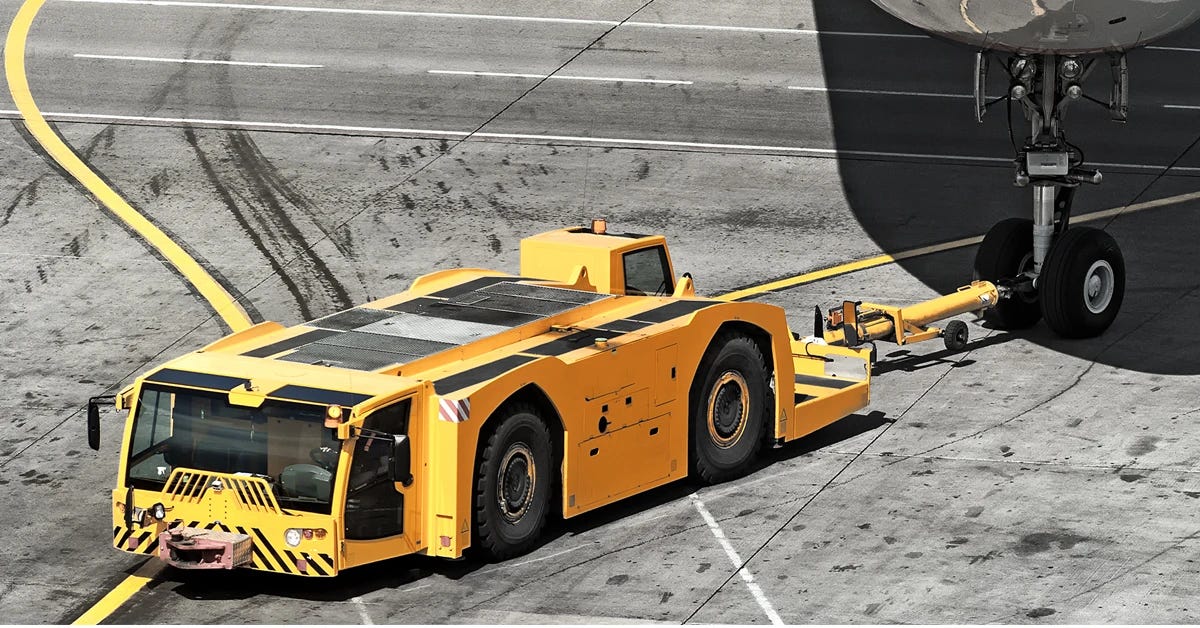
Image: a typical airport tug.
Clip: The Flight Channel’s explanation of the Melbourne near-disaster.
It’s amazing that a +/- 20% error in the weight data didn’t cause a more serious problem.