
La Brabançonne
Sunday musical excursion #41

Yesterday was a good day. I hope you had a good day yesterday as well.
Last year, my 34-year-old car decided it would assume the converse of the principal characteristic of Count Dracula’s coffin. Whereas the Count had to repair pronto to his sarcophagus come the first beam of sunshine on the morn, my car had to be consigned to the garage upon the fall of night. The headlights didn’t work.
Previous experience with the man who has cared for my motor mechanical needs for nigh-on 20 years had taught me that, while he never said no to anything, he had an inventive repertoire of ways to tell me he doesn’t like electrics. Always prefaced with, “Tu sais …” when, clearly, my standpoint was by that stage that what I did or did not savoir was beside the point. On this occasion, I humoured him by seeking out the services of an auto electrical specialist in Leuven. All that remained for me to do was find them. It’s at this point that the Internet proves itself utterly useless when what you’re looking for is auto electrics, and not electric autos. Which word do you exclude from the search criteria?
H. Rompaey were duly found, an appointment made and the car was delivered to them. Now, there is a certain scepticism in the mind of any customer of a garage that does all makes and, indeed, electrics don’t need to be make-specific. Except that there does come a point when, having determined they don’t work, you need to repair them. Then, the job becomes make-specific. “We haven’t had all that much experience with these cars, and yours is particularly old.” I didn’t hold back: I asked them if the cars they generally get in for repair are still under guarantee maybe, or are so badly made they go phut after a mere 20 years, instead of waiting the full third of century in my case. They identified a switch in the steering column that was stopping the headlights coming on. Could I order it for them?
Now, not many can boast this, but I have already seen the inside of the steering column of my car when Jean-Mich was doing a previous repair (I had the unfortunate habit at the time of hauling myself into the car using the leverage of the steering column and one day it went snap). Inside my steering column, so Jean-Mich told me at the time, are no fewer that 2,000 separate components. When you take it apart, you need a large bedsheet, a great deal of order and discipline and careful notes to be even remotely certain of getting the whole thing back together again. I told Rompaey to leave it this time. They were gracious enough not to charge me for their trouble and I was left with the sole option of getting on my bended knees to Jean-Mich: could he do it?
Tout est possible, was his reply. Even the steering column? He repeated himself to admirable effect: tout est possible. There was one condition: the temperature. Ambient temperature. He wasn’t on for scrabbling around under the cramped dashboard with minus temperatures in his tin shack for a workshop. When the weather turns fine.
Some time ago, and I really thought he was joking, which he does occasionally, despite the unfairnesses that life has dealt him, he’s suggested rewiring the car. You know, like you rewire a house when the wiring gets a bit frayed and the wire colours are no longer recognised by anyone who’s still a practising electrician. So much has been chipoté over time, the whole system’s a bit amateur. People haven’t even used the right colour wire, so when I go in to do a repair, I don’t even know what I’m looking at. I hesitate to tell him that the chipotage was all done by his former boss, if not him personally, but discretion, as Falstaff said, is the better part of the relationship with your garage.
We agreed May and early in May the car was taken down to far-off Charleroi. It’s an hour’s drive down there and people ask me why I can’t get a garage closer to where I live. And I tell them that Jean-Michel is the closest garage to where I live that I want.
The vehicle’s 4x4 changer wasn’t sliding over nicely back 20 years ago or more, and I took it to a dealer in Brussels, who first needed to study the manuals for the model. Nowadays, they’d be ringing up a museum. Main dealers are great if you have bottomless pockets and are happy to just expect the job to be done, cost no object. Main dealers are good for the new models, but pretty useless once your model is out of production. When, do you suppose, is it that a car needs most interventions? The first five years, or the next 25 years?
And all of the foregoing is the preface to why yesterday was a good day and why tomorrow will be a good day as well. Because yesterday, I went to collect my car. I took the train, and arrived at the station with only a short time to spare. There was someone at the machine, but they stepped away and beckoned me quickly to go ahead, and I selected my ticket. I was paying with coins and found I was one euro short. Lo and behold, the other gentleman gave me it. Then, all of a sudden, my coinage was returned to me. And along with it was a receipt. I grabbed the money, gave the man back his euro, took the ticket and we both went onto the platform, and got into conversation, and then the train.
He was on an errand of mercy. A friend of his had had an accident in Bruges and was being discharged from hospital, but had no clothes, as the ambulance driver had cut his clothes off his body when rescuing him. So, the man had a bag of clothes for his friend and was headed to Bruges. In the wrong direction, actually, but our station is only two stops from the end of the line, and it’s quicker to get a stopping train to Leuven and then the express to Bruges.
I was headed to Charleroi, and I can get there two different ways, via Leuven and Ottignies, or via Brussels. As it happened we were both going in the wrong direction, for two stops anyway. The last time I travelled to Charleroi via Ottignies (which is much more enjoyable from a scenery viewpoint), I also met a very interesting person on the station platform, a lady studying at the university, who hails from Saudi Arabia. This new acquaintance was from Iran.
When I switched to the Ottignies train, the ticket collector informed me I didn’t have a ticket. It dawned on me what had happened at the ticket machine: the machine couldn’t cope with the amount of small change, and had rejected it all. What I’d picked out of the tray was someone else’s old receipt. I was already reaching for my wallet, when she said, “You can stay on the train, the date and the time are all correct, so everything seems to be in order.” I was a bit dumbfounded but needed to change trains in Ottignies, where I quickly repaired to the booking hall and purchased a valid ticket for the section to Charleroi at least. The ticket collector on that train positively beamed as she checked my spanking brand new valid ticket, almost as if she’d heard stories down the line about me.
When we pulled into Charleroi Central, Jean-Michel was waiting for me in his car, and we motored up to where his workshop is. A few checks of this and that with the car, and then I needed to pay him. To my absolute horror, I was 50 euros short. I’ll transfer it to your account, or shall I pop to the ATM now? I bluster. He says, “I made you wait a month and a half longer than I said it would take. So, the 50 euros is for the delay.”
He hasn’t repaired the steering column, however. He replaced it. Cost him 375 euros. But he quoted a price, really by sticking his finger in the wind, and he won’t change that. Instead, he gives a discount, because he was ill for a few weeks. Now, who wouldn’t drive an hour for a mechanic who gives discounts, sticks to his word, does things for free and performs a taxi service to the station? Oh, and he’s quite a good mechanic as well. An Iranian lorry-driver, a Belgian railway ticket collector and my mechanic made yesterday a special day, because they filled it with financial benefit, but more than that, they filled it with humanity and kindness. I just wanted you to know that there is one place on Earth I can attest to where there was that yesterday: Belgium; and that’s no coincidence.
The greatest compliment ever paid to me was given me by a Brussels motorcycle cop who’d stopped me for making an unlawful left-hand turn. In fact the situation was such that I couldn’t see the prohibition, but we never got that far. He handed my licence back to me and said, “Vous êtes correct, Monsieur. Bonne journée.” That’s correct in the sense of all present and. In due and proper order. I don’t mention it because he said it to me, but because he said it to anyone.
Tomorrow, 21 July, it will be the Belgian National Holiday. It was not always on 21 July; until 1889, the National Holiday was celebrated on 27 September, the date in 1830 when the Dutch army retreated from Brussels. It would take King William II a further nine years to recognise our independence. But recognise it he did, and since then the two nations have been like siblings fighting on the back seat of a car: mostly in good humour, with one party constantly having to remind the other which one is the big brother.
But what has Belgium to celebrate? It’s not as if we were a great nation like the United States of America or the United Kingdom. Or are we?
First, we are greater than we were initially. After World War I, the East Cantons were hived off Germany and given to Belgium as reparations for its losses in the war. Some people wonder why there is a neighbouring country Luxembourg and also a province of Belgium called Luxembourg. Is that coincidence? people ask. No, it’s not a coincidence. They used to be together. When Belgium seceded from the United Kingdom of the Netherlands, the countries split according to ducal loyalties. Some duchies’ territories were scattered in little parcels, which explains the odd tourist attraction we have in Baarle-Hertog (in Flemish Brabant) and Baarle-Nassau (in North Brabant), with an international border running down the middle of people’s beds. Over in Luxembourg, the question was whether Belgium should get it or the Netherlands. The Dutch wanted to hold onto it (they wanted all the rivers and all the … tax havens). They were threatening to raise arms to get it, when Germany intervened and said We’ll have it. The Dutch immediately backed off, and the Belgians showed their very first inclination to compromise: they took two-thirds of the grand duchy as their own province of Luxembourg, and left one-third for the Grand Duke.
In 1921, Luxembourg and Belgium created a currency union. The Luxembourg franc and the Belgian franc were at parity from that year until their abolition in 1999, in favour of the euro. The shock and horror expressed by countries like the United Kingdom, Sweden and Denmark when European monetary union was proposed, that somehow they would lose all and any hands on tillers as far as monetary and fiscal policy was concerned, we somewhat laughed off in Belgium and Luxembourg, who had been learning quietly to cooperate with each other, instead of using fiscal policy as a weapon of war. You would almost think the non-euro states had a point until you look at what a cock-up they’ve made of their own monetary policy in the new millennium. Not exactly shining examples, eh?
All snide remarks aside, Belgium’s weakness due to its size and lack of potent strategic importance gives it the luxury that it is not tempted to exercise muscle it doesn’t have, and just gets on doing something constructive, a fact that some other countries might like to take note of, by exercising a little self-restraint.
Like the US, we gained our independence in assertion of the right of self-determination. Unlike the US, we asserted that right over territory that was already ours. When Gandhi told the British in India that they were masters in another man’s country, he could just as well have been talking about America.
Belgium is just 54 years younger than the United States. Belgium has, since its formation, been involved in a total of two wars. The First World War, and the Second World War. In both of them, its entire territory was occupied, and its people suffered great misery. But, with help from its friends, Belgium has on both occasions thrown off its invader. If there is a country on this Earth whose people know the value of peace, then it is Belgium, and we strive for it at every turn. We seek to settle our internal language squabbles, and we may take 300 days to form a government, but that is not a token of our simplicity, it is a token of how damned carefully we go about the matter. If anyone should have a permanent seat on the UN Security Council, it is Belgium.
I happened a while back upon a Notes thread about the greatest country in the world. The debate circled around, not which country it is, but whether the US is it or not. Substack can be an excursion into the parochial: instead of asking what constitutes greatness, by which we don’t need to query Shakespeare’s Malvolio, the contributors occupied themselves in arguing the US’s right to claim the accolade, if only because it has in its Constitution a provision that guarantees free speech. I know it does, and so do you.
Article 19 of the Belgian Constitution provides:
La liberté des cultes, celle de leur exercice public, ainsi que la liberté de manifester ses opinions en toute matière, sont garanties, sauf la répression des délits commis à l’occasion de l’usage de ces libertés.
People may worship what they please, including in public, and may manifest their opinion on any subject, except that any such expression under this freedom as shall give rise to harm shall be actionable in law.
We don’t have freedom of speech here. We have freedom of everything. But, our Constitution doesn’t just accord rights and leave them at that. It associates responsibilities with their exercise.
Article 25 provides:
La presse est libre; la censure ne pourra jamais être établie; il ne peut être exigé de cautionnement des écrivains, éditeurs ou imprimeurs.
The press is free; censure may never be imposed; no bond of guarantee is required of writers, publishers or printers.
This is very unique: there is no such thing as a gagging order in Belgium. You cannot prospectively prohibit an individual from exercising his rights of expression.
The Herman Brusselmans case also marks Belgium’s sense and ability to keep its head when all around are losing theirs: he published an article in the magazine Humo in which he described the feelings that rise within him when he sees a picture of a Palestinian boy wailing for his mother, who is buried beneath the rubble that was once their home. He describes his feelings in terms of wanting to take a sharp knife to the throats of the culprits. He shocked me with that, because violence is always to be abhorred. But, although prosecuted for hate speech, the prosecution failed to surmount the test of special intent under our law, because Brusselmans did not incite anyone to commit a criminal act. He simply described how he felt. He was acquitted.
If I contended that Belgium is perfect, I’d be contending that I or any man is perfect, and that is nonsense. But we have things here that the best of the rest cannot lay claim to, and could do well to take inspiration from. And, if it’s inspiration one seeks, what better form than a national anthem?
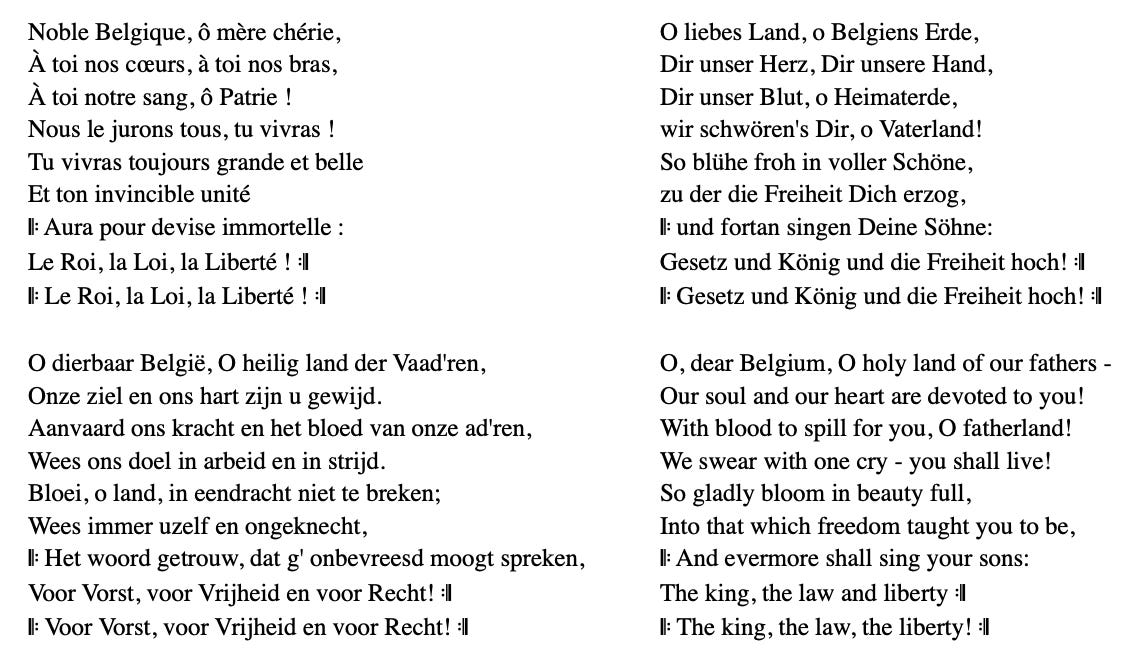
We have three languages in this country: French, German and Dutch. In the music that follows, you can hear all of them, one after the other, in the singing of our national anthem. Anyone who saw my recent diatribes against national anthems may wonder at this musical excursion today. Call it whimsy or call it logical exception: the translation of the words is included, and if you see anything in there that vaunts that we are better than you, then I’ll take your point. Otherwise, this is quite an astonishing rendition: Helmut Lotti is a celebrated Flemish singer of many styles, but Dutch is his first language. It is one thing to sing another country’s national anthem, but to sing your own in another language is a cross-cultural dissection, because national anthems and language are both cultural phenomena that go to our hearts. It’s the fact Lotti acquits himself so excellently here, and that in the presence of our dearly loved King, that makes this a very special performance. I hope you enjoy it. Joyeuse fête nationale. Prettige nationale feestdag. Ein glückliches Nationalfest.
La Brabançonne - De Brabançonne - Das Lied von Brabant
Words by Alexandre Dechet, music by François van Campenhout
Performed in 2013 by Helmut Lotti before T.M. King Philippe and Queen Mathilde of the Belgians, T.R.H. Prince Laurent (the King’s brother) and Princess Astrid (the King’s sister), and H.M. Queen Fabiola (the King’s aunt, who died in 2014)
That is amazing. Both car, and law, and national song/anthem. Thank you for posting this. My father told me he passed through Belgium during WW2, and no one offered food or water to him or his fellow British soldiers. I am glad to read something so positive, kind and cheerful about Belgium.