
Opening up to migration will starve slavery of its oxygen
Just as decriminalising homosexuality starved blackmail of its

Eleven years ago, Monica Sud raised a court action against the American wholesale distributor Costco. Her complaint was that Costco was selling prawns that were cultivated using fishmeal that was produced by slaves. Her plea in law was that the prawns should be marketed with a label stating that they were “produced using slave labour”.
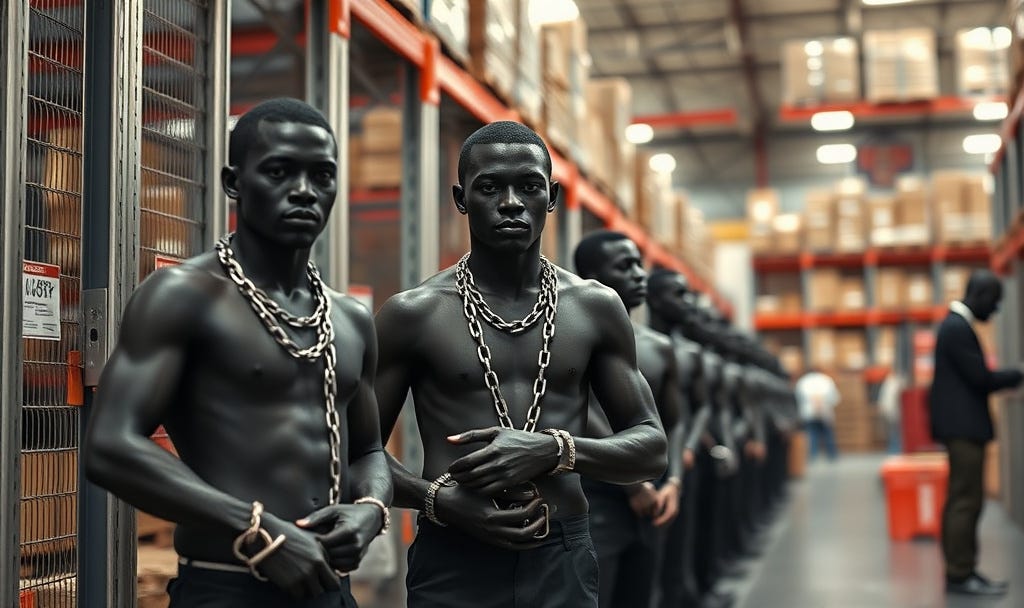
“The action follow[ed] a Guardian investigation in 2014 that tracked the complex prawn supply chain and reports by the UN and non-governmental organisations, including the Environmental Justice Foundation, that human trafficking for forced labour and slavery have become endemic in the Thai fishing sector.” (The Guardian, 19 August 2015.) Sud lost the action on a technicality: she could not prove that she had actually purchased the seafood in question.
It’s not just Thailand, it’s Myanmar. It’s Uzbek cotton. It’s still the sweatshops where On Running’s shoes are manufactured (yes, those circular shoes of Roger Federer’s, which each year cost you 420 Swiss francs (CHF 35 a month; approx. 530 U.S. dollars annually) and which you chuck away after three months for supposed infinite recycling). It’s 40 million people around the world. The British abolished slavery in 1833 and yet it’s a problem that is more rife now than it ever was in the days of the empires. These are the days of the empires, but not geopolitical empires as such: the commercial empires, where platitudinous commitments to verifying sourcing and supply chains ring hollow as holding structures and blind eyes result in more observance in the breach than in the rule.
When the purported societal scourge of homosexuality was decriminalised in England & Wales in 1967, it wasn’t done as a liberal gesture to allow free practice of preferences by those of another sexual orientation. It was done to put an end to the scourge of blackmail. The Sexual Offences Act was no piece of grassroots legislation, clamoured for by building-site rent boys and intersexual poets. No, it was the brainchild of a Conservative MP frightened of being held to financial account for his proclivities and, in that, he was supported until, by the time it was passed, the bill was government policy. Except in Scotland and Northern Ireland, where Humphry Berkeley considered opposition would be great enough to see its defeat. Only the English and the Welsh were forward-looking enough to support it in its first iteration, and support it they did: it became law on 27 July 1967.
But it was not an act to liberate homosexuals from prosecution for their acts of love; it was a law to protect them from extortion by those who knew of those acts, who had learned a very stark lesson only too well in 1953. That was the year mathematician Alan Turing was precisely prosecuted after inadvertently revealing to a police officer the relations he had had with a suspected burglar at his property. That was a signal to extortioners that was received loud and clear: that the blackmail industry was still up and running after the louche goings-on in quiet corners of the blackout during the Second World War, over which a veil had been drawn at the time on the pretext of having better things to do than prosecute front-line soldiers, like Field Marshal Bernard Montgomery.
If you want to know what that’s got to do with the price of tomatoes, it’s this: many of those who flee to western shores do so precisely to escape the kind of oppression and slavery that characterises the places they come from. Some of them fall into the hands of traffickers, to whom they render up their last dime in a hope of reaching somewhere where they can breathe again. Whilst pretty corporate brochures and governance statements make clear how very against slavery and sweatshops western organisations and corporations are, time and again they are found to be wanting in the field (the On Running story is of particular note).
Human traffickers thrive on the need of the afflicted to flee. And the invidious position that even those who successfully file an asylum claim in the west often fall into means that they flee from slavery only to end up in slavery again. What aliments slavery is the containment of the slave, whether by force or by circumstance, with the absence of alternatives, and the imposition of violence and cruelty. I believe the west could go a long way toward stifling the slavers by simply opening up to migration. If you made available the option of fleeing to a country offering opportunity and a new start in life, not only would slavery be diminished in the destination countries to which the enslaved flee, but it would work its way through to the very countries that they flee from: their ability easily to escape their enslavement would render slavery of no object. Slaves remain slaves because they have no other choice; give them another choice, and they cease to be slaves.
It sounds so disingenuous: the best way to stem illegal immigration is to make immigration legal. By legalising it, you starve traffickers of their raw material. By making it easy, you starve slavers of their raw material. If people can up and leave so freely to another country when the slavers come to town, the slavers will be less inclined to come to town, and slavery will reduce in the source countries, which means that there will be less desire to flee to emigration destinations. Decriminalising illegal immigration—if that doesn’t sound too daft—could even end up stopping it altogether, as far as migration impelled by slavery is concerned.
There is also migration impelled by conflict and, quite simply, people would flee conflict less if there were less conflict to flee from. The immigration problem of which many western nations despair is created in large part by their own acts. It is as if they want the problem to exist, because it solves another problem somewhere else, which lies in a less obvious place.
Of course, one might cynically, therefore, add that, in spite of all the high-sounding rhetoric of corporate managers and highfalutin statesmen condemning slavery and vowing to root it out wherever it may subsist, effacing slavery from the surface of the world is the last thing that the west would ever want to do: the existence of slavery in places like Bangladesh, Burma, India, Birmingham, Saudi Arabia, Qatar and many other places precisely serves the western thirst for cheap labour. That is another matter: this thirst will only be quenched when it has become plain to the world’s industrialists that the fundamental purpose of a commercial enterprise cannot be to maximise profit for its shareholders, but must instead be reframed as being to contribute to the well-being of the society within which it exists—with which it takes bread—com-panis—company. If profit there be once that primary goal were achieved, the shareholders might enjoy it on a proportionate par with the benefit inuring to the business’s workers—those who laboured to create it. If we are to make any progress towards seeing the end of slavery, we must expunge the entire concept of profit maximisation from our vocabularies.
Not until the world’s entire race lives sustainably and with a sufficiency of sustenance, supplied with clean water and pure air, and free from the oppressions of man, his financialisation of the markets and his impositions on the climate around us, shall we be able to say that slavery is a thing of the past. And doing away with slavery benefits not only the slave, but also the enslaver in the end of the day. It is to that mindset that we need to switch, because it is the tendency to enslave, be it totally or incrementally, that thwarts the democratic ideal at every turn. Even governments and their elected representatives are enslaved in the modern era. They, more than anyone, must be obliged to concede that, to lose their chains, they must relinquish the funds that have captured them.
Opening the west up to immigration will be a major plank in the fight against modern slavery, just as the decriminalisation of homosexuality was a major plank in the fight against extortion. That’s not even a patch on trickle-down economics; it’s gush-down direct consequences.
Correction: this article was updated on 4 June 2026. The price of CloudNeo shoes from On Running was originally stated to be 140 dollars per annum. In fact, the subscription price for the shoes is 35 Swiss francs per month, resulting in an annual cost of roughly 530 U.S. dollars.
https://music.youtube.com/watch?v=wDZFn9_rVLU&si=skv2MNndEOCgLGZW