
Running the world without politics
How Iran, Syria and New York removed politics from the system

They were going to call it Southern Syria. That sounds vaguely ludicrous to our modern ears. Southern where? Syria? Where is Syria, anyway?
Here it is:
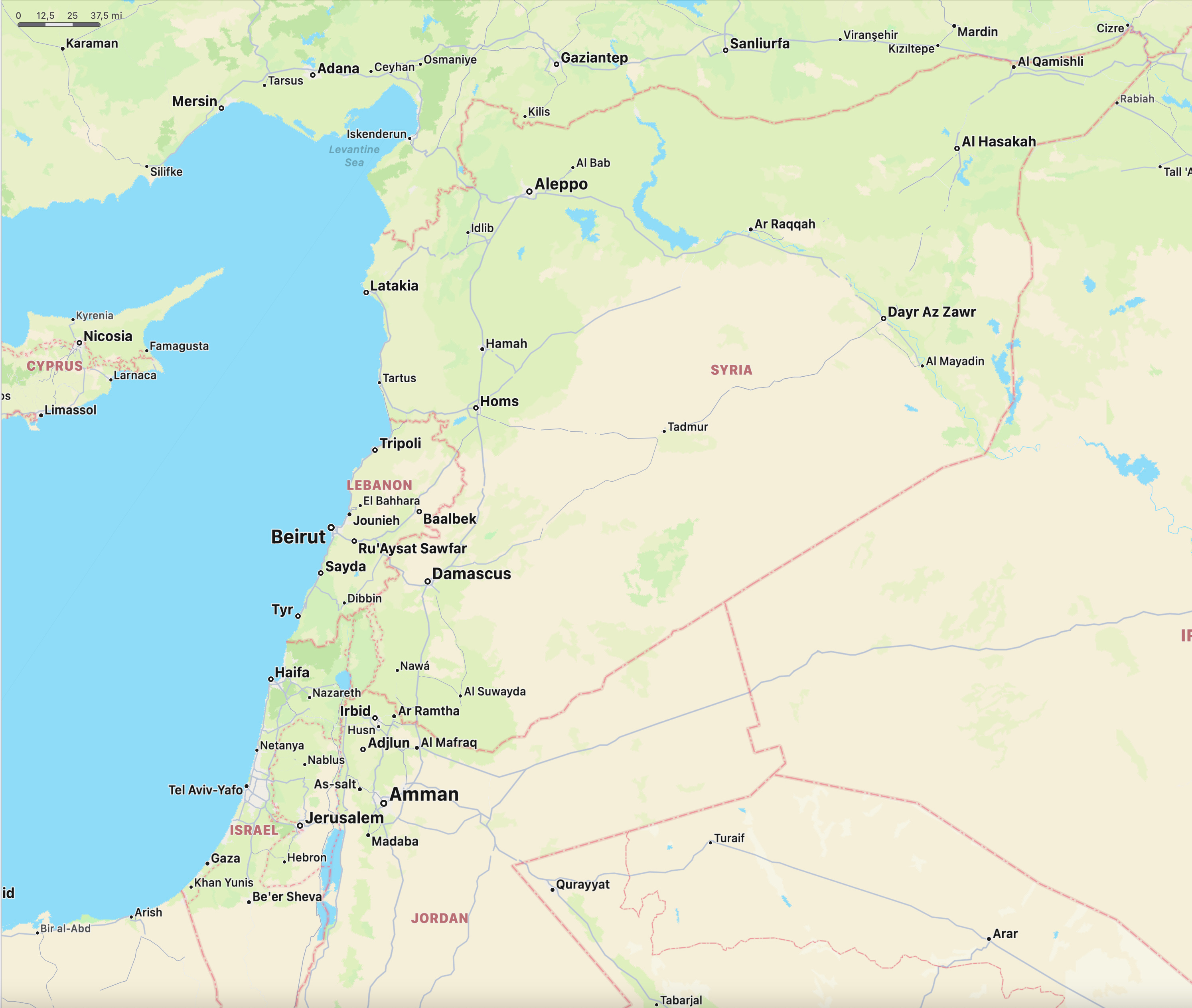
It is big. It has Iraq to its east, Jordan to its south, and jammed between it and the Mediterranean Sea are Lebanon and … Southern Syria. There were rival names for the territory, however. One was Filistina, and that’s what it became known as, for all of 30 years. Palestine, never a nation-state, always a region: a region that never truly had fixed borders. Even the map contained within the League of Nations mandate put one major settlement on the wrong side of the border. But, under British rule, Palestine became an entity, and London moved in with plans to change everything in due course, a promise it had given back in 1917. The other alternative name put forward at the time of the mandate would ultimately reign supreme: Land of Israel. Not republic, or state or country (as Trump would have his current nemesis: Country of Iran), but Land of Israel, for that, contended the Zionists, was and is the correct translation of the Arabic Filistina. Israel is how we now know what was then proposed as Southern Syria, but its borders are no more fixed today than they were when the mandate was established. Not in the past hundred or so years have the borders of Palestine, Israel, call it what you will, been fixed in any sense of permanence.
While there are serious philosophical and political bones of contention between the various branches of Islam, especially in the Middle East, be they Shi’ite, Sunni, Ba’athist, etc., the importance or otherwise of which may be fundamental or mere trifles (to use another Trumpism), it escapes nobody that the existence in the middle of the Middle East of the Jewish state, under whatever name, constitutes a gargantuan outlier in the region, even regardless of its diminutive size when compared to its northern namesake manqué: the Syrian Arab Republic. One might view it as one would view an enclave. Monaco, perhaps: an island of ultra-wealth sandwiched in between the Corniche and Italy. Or West Berlin: a catheter of western decadence planted deep into the heart of the East German capital. Or Gibraltar: an imperial citadel plonked onto the tip of Spain in order to exercise British maritime hegemony, while into the sea over which it holds sway it pumps its untreated, raw shit. What an allegory.
Far from Israel’s purported significance as a home for the banished and downtrodden Jews of eastern Europe, it’s prime role is to act as the syringe through which Britain and the west inject their odious influence into Western Asia, and especially its oil reserves. Aside from a little oil under the sea area that is nominally part of Gaza, which the Israelis have been purloining for some considerable time themselves, Israel is pretty useless to anyone in terms of its oil output, and that’s even if you include the olive variety. If Israel was sitting on pots of crude oil, you can be sure that it would not be the darling of the west; no, they would already have moved in and started running the place. It’s not oil that the west wants from Israel. It is its proximity to other people’s oil, and, perhaps most importantly, its rabid readiness to wage wars. That is what makes Israel an asset for the west, and for Britain in particular: fixer, henchman, disco bouncer.
The promise of the British during World War I was that they would help the Arab Revolt establish a unitary Arab realm stretching from the Red Sea to Mesopotamia. A single country (what ISIS would later dub a Caliphate). The lines that you see on the above map, straight and angular for the most part, were put there by the victorious powers after the fall of the Ottomans, to divide their empire up between France and Britain. Friendly kingdoms were created, headed up by Hashemite kings in Transjordan (later, Jordan), and Iraq. Lebanon and Syria fell under French control, thanks to Sykes and Picot. Palestine remained (and remains) a colony—it was really better off under Turkish rule.
Syria’s post-World War II history was tumultuous. After securing the withdrawal of French imperial troops in 1946 after it played a role as a founding member of the United Nations, Syria underwent a whole series of internal conflicts and coups d’état. Aside from the case of those dissidents who fell foul of his iron fist, a sense of calm did settle over the country with the establishment of a one-party state in 1970 under Hafiz al-Assad, who would rule until his death in 2000, when he was succeeded by his second son, Bashar.
When we think of the Middle East, there are names that spring to mind as indissociable from that geographical term: Palestine, Israel, Iran, Iraq, Egypt, Lebanon, UAE, Saudi Arabia, the Suez Canal, Yemen. And, if we push ourselves, yes, the name Syria comes to mind as well. A lot of the others are significant for a number of reasons—the only democracy in the Middle East, the 2003 war on terror, international shipping, oil, the Burj Khalifa. But, ironically, none of these is as important as Syria, for Syria does not take its place in our consciousness because of a thing, but rather because of an idea. One that knew a similar gestation at precisely the same time in a place 9,000 kilometres away, in New York. The idea was this: that you can run the world without politics.
That sounds absurd. Like saying you can dive to the bottom of the sea without drowning. Or you can fly across the oceans by flapping your arms. Or that you can run motor cars on water. But, in 1975, there started a process by which politics became … irrelevant.
Several years ago, I was on vacation on the eastern seaboard of the United States. My companion and I were in the old capital of Philadelphia, and it was July. Philadelphia is unbearably humid in July, so that people like us, unused to the oppressive heat, can barely venture more than a few yards outside on the street. Nevertheless, this was my first, and, for all I knew, my only visit to the city, so I wanted to see all of its aspects. We set off on a saunter down one of the main shopping streets and I quickly noticed that the store fronts had been window-dressed in a style that could best be described as minimalist. In each huge, plate-glass fronted display were to be seen maybe a couple of mannequins, and a few fashion items strewn here and there. I discovered the reason in due course. On the other side of the building ran a covered concourse, which was air conditioned. Inside, along the more mall-style walkway, the stores were displaying their goods to the full. Everything was on show in the unreal portion of the street, the air-conditioned part, whereas the real portion of the street, outside in the open air, showed very little. You had to know where the unreal part of the store was located, because if, like me, you just assumed that all stores open out onto the street, you would get a very distorted impression of what the store had … in store for you. The moral for my present purposes is this: when you remove politics from the system, you can’t just stop dressing the display windows. You continue to set out a few mannequins on the oppressively warm side of the building, whilst all the goodies are actually on show on the unreal side of the shop. You can’t leave casual shoppers on the street to mistakenly gain the idea that the shop has closed down, after all. Between the real world outside, where a pretence is displayed in the store fronts to give the impression of normality, and the unreal world in the air-conditioned mall, where everything feels much more comfortable but is only a product of artificiality, stands the store itself: a paragon of real unreality, into which we, like the stalkers in the Russian Strugatsky brothers’ science fiction novel Roadside Picnic, tread warily, observing the disjunctures between normality and absurdity, and accepting them willingly for no better reason than that we are a part of our own perceived reality.
Hafiz al-Assad had a touch and go relationship with the American foreign secretary Henry Kissinger. Kissinger was a ruthless man who placed himself firmly above the petty considerations of legal propriety and international law. For that reason he would be branded a criminal, but name me a U.S. foreign secretary who wasn’t. Name me any foreign secretary who was never involved in some kind of illegality or another, come to that. Al-Assad had the same dream that Prince Faisal had during the Arab Revolt: the establishment of a singular pan-Arab state, with him at its head. He favoured the right of return of the exiled Palestinians, and he thought that Kissinger did as well. But in 1975, Kissinger brokered a treaty of mutual recognition between Israel and Egypt, whilst assuring al-Assad that he still backed the pan-Arab state. When al-Assad learned he had been duped, he could barely contain his fury. But Hafiz al-Assad was no Donald Trump, and lived by the motto that revenge is a dish best served cold.
In 1982, the Israeli occupiers in Lebanon, who had invaded in order to encircle the refugee camp at Shatila, in Sabra, Beirut, stood by and allowed Christian-Lebanese militias to slaughter literally thousands of exiled Palestinian civilians. The U.S. sent peacekeepers in response to the world’s shocked outcry, as part of President Reagan’s avowed mission from God: Into the hands of America God has placed the destiny of an afflicted mankind, he said in a TV address. God bless America. What Ronald Reagan failed to appreciate was that Henry Kissinger had already structured the world precisely in order to afflict mankind, and the B-list actor was about to find out how. The putatively non-partisan peacekeepers that Reagan sent were viewed by al-Assad as an attempt by America and Israel to split the Arab world into factions, and the Syrian leader set to with his plans to evict America from the Middle East for once and for all. And he would not do it with tanks, or with missiles or with rhetoric or with machine guns, but with people. Human beings. The idea came from the country we now know to be supreme masters in asymmetric warfare: Iran. The weapon was the poor man’s atomic bomb: the suicide bomber.
Anyone who has watched the 1967 Hollywood wartime blockbuster The Dirty Dozen will know that the film is predicated on a suicidal mission in preparation for the D-Day landings, for which the operatives are recruited in a military prison. The reward for the prisoners is that, if they survive, they will be free. The downside is that the chances of survival are slim in the extreme. Somehow, western audiences can watch that kind of entertainment and feel a sympathy for the soldiers fighting—literally— for their lives. Perhaps because these bad guys are in fact the good guys. But a suicide bomber? One of them? Suddenly, the same audience cannot fathom the apparent lunacy of sacrificing oneself in an explosion that might take out dozens or hundreds of innocent civilians. On a bus, in the street, anywhere. That is pure terrorism. The counter-argument is that the Palestinians slaughtered in their thousands in Sabra were also innocent civilians. They had no firearms and the militias did. The Jews allowed the Christians to slaughter the Muslims: how do you take action against that? If you have no tanks, no missiles, no machine guns, only yourself? Words will not affect them, argument is in vain, you can stand before them in civil disobedience, but they will simply mow you down. So, you strap explosives to your body and inveigle your way into the midst of the enemy, and destroy yourself and them along with you; to make them change their policy, for the benefit of those in whose name you commit your act of self-destruction: your fellow countrymen. That is the goal: to make the enemy change its policy. And if its people will not advocate for the change in that policy, then they are complicit and no longer innocent. Thus the terrorist’s reasoning: TINA. There is no alternative; there are no innocents. It’s an argument Israel has used for genocide in Gaza: that there are no innocent Palestinians, so that, as a philosophy, it teeters on the brink of being turned against you. Ayatollah Khomeini devised suicide bombing as a means to uphold the ideals of the Iranian Revolution, by extending the annual ritual of self-flagellation in order to comprise self-destruction, albeit with the sole aim of defending the Revolution, and thus compatible with the Quran’s prohibition against suicide per se. So he said.
When you consider the wars of attrition in the French and Flemish trenches in World War I, or that which is taking place in Ukraine as I write this, in which hundreds of young soldiers have perished with minimal gains of territory, then the tactic employed by Iran in its war with Iraq somehow makes perfect sense. Iran sent boys and young men by the busload to the mine fields laid by Iraqi troops, and they walked out into the fields to certain death, thereby clearing pathways for the Iranian army to follow and engage in battle with their Iraqi foes. It is something that we in the west cannot get our heads around. And yet it is easier to comprehend than you might think.
When war breaks out, the young men of a nation will do one of three things (besides scarpering). They will declare their conscientious objection and refuse to don the uniform, on the ground that they are unwilling to raise a firearm against another human being. Or they will be called up by the conscription office and be forced to don the uniform, for want of their conscientious objection. Or they will enlist: they voluntarily sign up to join the war effort. Those who are conscripted may survive or may die. They don’t know which, but they hope they’ll survive. However, those who enlist in fact never expect to see the peace. The emotions and determination that impel them to sign up render them blind to the prospect of their death. They do not hope to die, but the reasons that move them to join up mean that they are almost insouciant about living. Like Hotspur in Henry IV: Let us eat, drink and be merry, for tomorrow we shall die. So, what of the conscientious objectors? Does objecting to being ordered to kill another stand in the way of being ordered to kill oneself? Does it make you feel queasy to send a young boy off to his certain death? How many of the Australian troops sent to Gallipoli in World War I were not sent to their certain deaths? And, to what end? The boys sent to clear minefields in Iran knew for certain they would die, but they also knew for certain that they would make a valued, and invaluable, contribution to the war effort. Iran is a country that does not challenge our sense of civilisation, but rather our lack of it.
On 23 October 1983, ordered by Hafiz al-Assad, President of Syria, and financed by Ruhollah Khomeini, Supreme Leader of Iran, two Hezbollah suicide bombers entered the U.S. Marines’ barracks in Beirut in trucks and exploded their devices, killing 241 American service personnel, as well as themselves. Astonishingly, it worked. The following February, the U.S. quit the Middle East. In the 1960 movie It Started In Naples, starring Clark Gable and Sophia Loren, the following exchange takes place between Lucia (Loren), Hamilton (Gable) and a number of Lucia’s neighbours:
First man: Lucia, what’s going on?
Lucia (Sophia Loren): Nothing, the American wants to kidnap Nando and take him from Capri—for what purpose I do not know.
First man: Why don’t you get out of the Middle East? All you want is oil, oil, oil.
Second man: Oil, oil oil.
Lucia: No, no—he wants Nando
First Man: Soon he wants oil too—oil!
Lucia: Please, everybody, don’t disturb yourselves. Just because he has come here to buy a poor Italian child with American gold.
Third man: What does he want?
First man: He wants to steal Nando, the American. He’s a gangster.
Second man: He’s a gangster.
Hamilton (Clark Gable): I just want to see this kid to get a decent chance in life, like the kids in America.
Woman: America? My daughter she goes to America. What happens? Pregnant!
Second man: Pregnant!
Hamilton: It couldn’t have been Philadelphia.
Woman: It was Philadelphia!
Hamilton: My brother left ten years ago!
Well, the guy shaving at his window, the first man, he asks why don’t you get out of the Middle East? And 24 years later, Assad did it. He got the Americans out of the Middle East. With suicide bombers. And it was a powerful armament indeed. Not because it could cause the deaths of the unsuspecting, and thereby change policy in far-off places; but because it could defeat the scourge of the world.
Corruption is the ultimate tool of self-preservation: those who are open to it are willing to allow others to be compromised and destroyed in order to ensure their own selfish survival. Fighting the corrupt with one’s own self-destruction is the exact opposite of that. Instead of sacrificing others to ensure your own survival, you sacrifice yourself to ensure the survival of those who love peace: your Muslim brothers and sisters. So the philosophy of suicide bombing. Again, it can turn against its proponents, for Israel’s current lurching headlong into a state of insanity, as some see it, in gung-ho pursuit of self-destruction can also be viewed as the fulfilment of a religious destiny. For Muslims, the achievement of eternal peace; for Jews, the achievement of the apocalypse.
Suicide bombing is warfare that is so asymmetrical that it doesn’t even need a declaration of war. It strikes anywhere, any time, and is devilishly difficult to detect, not least because it comes without a uniform or a camouflage-coloured armoured car. It was one way in which Iran and Syria, and their proxy forces, Hezbollah, Hamas and the Houthis, could wage war against unwanted forces within their sphere of influence, for instance Israel, and, although its deployment is seemingly less prevalent today, we still see Iran engaged in an inexorable endeavour to eject America from the Middle East, which may in fact end up succeeding. And together with Iran’s efforts to overcome the enemies attacking it from around the Persian Gulf militarily, America would seem unwittingly to have delivered into its hands a means by which to defeat the other tool by which the world is run without politics. The one that also started in 1975, but 9,000 km away from Damascus, in New York.
New York in the 1970s was filthy. It was dangerous and it was bankrupt. The pushers and hookers had crept out from 42nd Street and now brazenly paraded up and down Broadway. Harlem was nearly a no-go area, and crime was rife, as Richard Rowntree could attest. It was not yet the era of the 1980s, when Donald Trump would sweep in and buy up derelict properties to convert them into penthouses and glass and steel office blocks, but the institutions that would only too gladly help Trump establish his empire in the city were already active at city hall: the banks.
In 1975, the city of New York did what it did most years, which was to issue debentures (bonds) as security for loans issued by the big banks. The problem in that year was that the banks were not interested. They were finally of the view that the city had overstretched itself, beyond its ability to honour the debts. They held out and the city cried to the federal government in Washington, which told New York it was on its own. With no one else to turn to, the city fathers agreed that New York would be governed by a committee of nine members. One of them was a city councillor, and eight of them were bankers. In 1975, the biggest city in America handed over its democratic governance to financial institutions and, little by little, it has effectively been followed by pretty much every city in the world ever since.
The banks immediately introduced a policy that is world famous today: austerity. Public employees like firemen, teachers, police, street sweepers, were all fired; the banks engineered the city’s finances to feed their own coffers. And, what’s more, nobody objected. The financiers portrayed the situation as another TINA: there is no alternative, and that is how the politicians sold it to their electorate. Most of the middle-class earners had already quit the city, so that the take it or leave it alternative by which the policy was sold to the people was not one the people in question had many resources with which to challenge the situation. The banks and financiers became the core of the government, and the government that people elected turned into window-dressing. Mouthpieces for policy that had been pre-honed in board rooms. Whoever you elected to office was not there for the people who elected them, nor even for the entire electorate, whatever their colour. No, it was there to serve the interests of the financiers. What we are now seeing in London, in Kyiv, in Moscow, Paris, Berlin, Brussels, Washington, D.C. is the culmination of a process that started 50 years ago. We have been told to acquiesce in the power of the market, the same power as we believed in when they privatised our water, electricity, gas, railways, national parks, ferries, and our legislative processes; to bow down before the inevitability and unchangeability of the way our lives are run by forces that have no role whatsoever in politics, because they dictate policy from an entirely different place than the ballot box.
The fairy tale of Rumpelstiltskin turns on the notion of power. A miller’s daughter can spin straw into gold, and is imprisoned by the king until she has done exactly that. An imp comes and says he can free her if she will give him her first child. (Yes, it’s a children’s story, but not really for children.) Anyhow, she agrees, but when she bears her first baby after marrying the king, she offers wealth instead of the child. The imp relents if she can guess his name and, after a bit of chicanery from listening to a song he sings in which he mentions his name, she guesses it correctly: Rumpelstiltskin. The imp is mad, but has no choice but to honour his bargain. One of the multitude of morals of the story is the power that knowing someone’s name gives you over them. It is perhaps the fact that the name Donald Trump is so well known that is our first indication that we do not need to have power over him. It is those who lurk behind him, whose names we do not know, over whom we need to acquire power.
The financial world is to a great extent anonymous. It has no names. It is a world of numbers, accounts, algorithms, balance sheet totals. It is not the world of trade, despite the fact they call it trading. It’s not the world of business, unless it’s monkey business. It is a world that knows no reality for the average voter: the ability to make millions of dollars in a day is beyond all contemplation. A billion is a million one thousand times. A million is what a few of us may actually earn in our entire lifetimes. So, write “a million” a thousand times, one per line. There are 30 lines on an A4 page, so that is 34 pages, just with the word “million”. A thousand lifetimes’ earnings. And that’s just one billion. If you believe that a single person can rightfully possess that level of earnings in just one lifetime by operation of the free market, then either you have a strange conception of what is a free market or you believe in fairy tales. Like Rumpelstiltskin, for example.
When the English revolted against Charles I, they chopped his head off, because they knew where they could find him. When the Russians stormed the Winter Palace in St Petersburg, they knew where to find Nicholas and Alexandra. The French didn’t have far to look to find Louis XVI and Marie Antoinette. But, if you want to wrest power back from the gnomes of Zurich or the tech bosses of Silicon Valley or the financiers of Wall Street, where will you go to look for them? The Cayman Islands? Monte Carlo? The Maldives? The ballot box?
Everyone wants politics to be cleaned up. They want rid of the Epstein Class, and they want everything to be as it was. No one has any objection to a little bit of corruption, as long as it benefits me, and not the people who are benefiting from me. As long as it gets me the preferential treatment and not those people down there. Freebies are all right, as long as they’re for me, and not for immigrants, and I don’t care what dirty work immigrants do that I won’t do. We are frightened of what we cannot see, like ghosts in the night. But why, then, are we not frightened of financiers who play our politicians like puppets on a string?
I’m not telling you to go out there and blow yourselves up. But, if you do decide to do so, know why you’re doing it, and what cause you are supporting and what slobs you’re going to take out with you. Because wishing you were on the inside of the tricks by which it all operates will not get you anywhere. It’ll just make you their stool-pigeon.
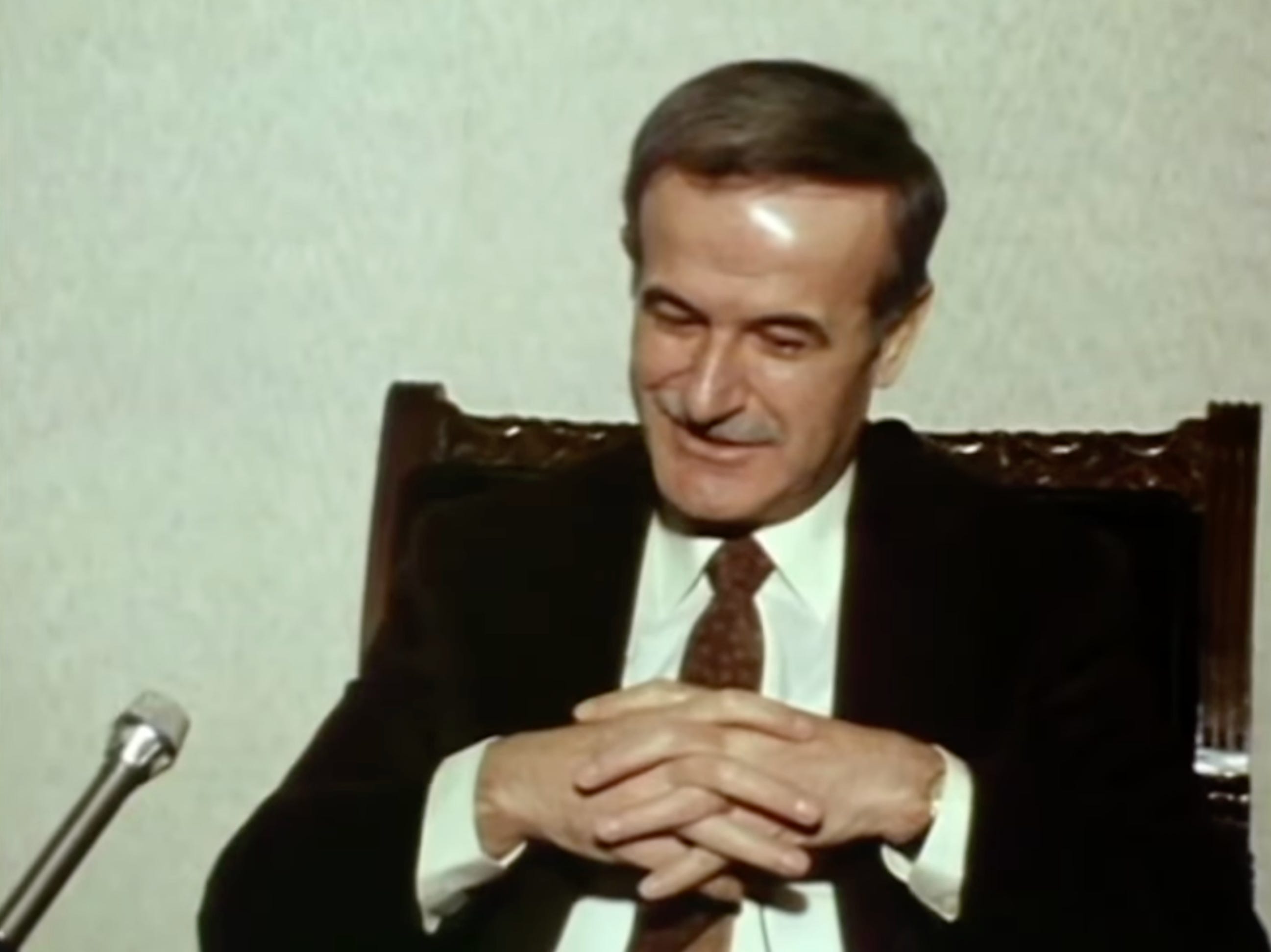
Image: Hafiz al-Assad, President of Syria 1970-2000.