
Sinterklaas
Something to rely on

Yesterday, across northern Europe, in among the Christmas preparations and the football, 6 December was celebrated as Sinterklaas, the feast day of Saint Nicholas, the patron saint of children. Naughty children get admonished, and nice children get rewarded. I was clearly a nice boy, because my house mate had prepared a beer glass with choccies and cinnamon biscuit for me, which of course appeared out of magical nowhere. For centuries, this was the day on which children stood central—the religious day of their patron. Gradually, from America and Britain, there emerged Santa Claus, their own version of Saint Nicholas, and the emphasis shifted from 6 to 25 December. The commercialisation of Christmas then made Belgian, German and Dutch children look on in awe: at the wonderful presents kids in other parts of the world received only two weeks later than their little bags of chocolate, speculoos and perhaps a doll and an orange. They didn’t relinquish Sinterklaas, but Santa Claus became an adopted figure as well, like Hallowe’en, and, like Hallowe’en, for all the wrong reasons.
Many years, if not decades, ago, the store where I work instituted Santa’s Grotto for this season. One of our employees is a burly fellow with a bushy beard, which he lets grow to its fullness from about October time. Then he installs himself in a grotto-like scenario on the second floor and welcomes children old and newborn with a hearty yo-ho-ho, and always a little gift, all offered free of charge by the management, and children and parents alike relish the experience. However, we have two locations, one in Everberg and one in Sint-Genesius-Rode. Yesterday, he was in the latter of these two. I was in Everberg.
A lady of young parentage years approached me with a kindly enquiry. “Is Father Christmas here today—we’ve come to see him?” She was in the company of a small, slightly bashful young girl of about 4 years of age. My reply was somewhat business-like to begin with. “Oh, he’s down in Sint-Genesius-Rode today. He won’t be here until next week.” Then, I noticed the wee girl. Her left hand was up at her face and she’d turned her head towards her mummy’s side, and I suddenly realised that she might burst into tears, and my heart went out to her.
Her mummy said in a well-acted voice, “Oh, we seem to have got the dates wrong. But that makes sense: there is only one Father Christmas, and he cannot be everywhere at once, can he?” The little girl looked up at her mummy and nodded in agreement. “That’s right,” I replied, “But next week is not so very far off, now, is it?” This flawed logic comforted the wee girl. “We’ll come back next week,” continued the mother, “And then we’ll see Father Christmas.” And a glimmer of a smile emerged on the child’s face.
Yesterday was the day of children where we are. Every day should be a day of children. They need something, someone, that is warranted never to harm them, never to deceive them, on which they can count and rely, and which they can know with certainty will always, always, always be there for them, world without end.
A lone tear was wiped from my own eye. Just as do we all.
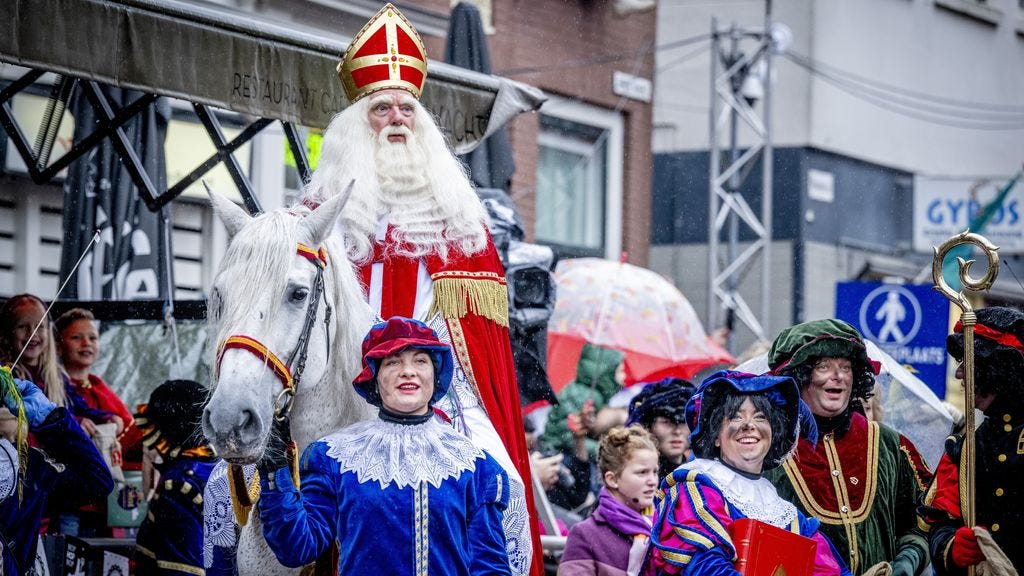
Image: The Sint does his grand entry into the Dutch city of Gorinchem.
Very young children do BELIEVE in Santa Claus. Are we wrong to encourage this erroneous belief? Should we dispense with "benevolent lies" and give them the unvarnished cold hearted truth?