
Towering infernos
Fires are often best extinguished with water, dear Henry, dear Henry, dear Henry

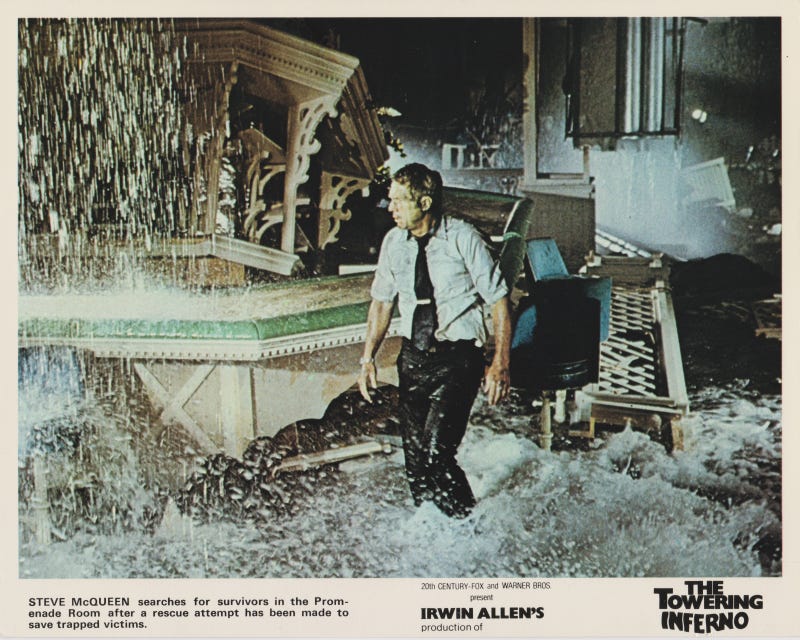
The Towering Inferno is a 1974 movie starring Paul Newman, Steve McQueen, William Holden and just about every other actor who happened to be hanging around Hollywood at the time: Faye Dunaway, Robert Vaughn, Robert Wagner, Richard Chamberlain, Jennifer Jones, Fred Astaire, O. J. Simpson, and, and, and. By far the best portrayal in the whole film is in my humble view that by Sheila Matthews Allen, who plays Mrs Ramsey, the wife of the mayor of San Francisco, where the movie is set.
The Towering Inferno is of the disaster genre, and is all about a tower that becomes an inferno. It involves people being burned alive, falling out of windows and being crushed to death, so, it is a good example of the genre it represents. In common with virtually all disaster movies, nearly everyone has a bit part to play, rather than a main lead. The plot is less designed to follow a given character’s development through the story and more to demonstrate how the character interacts at various stages in the storyline.
The characters fall into three categories:
(1) the dispensable: ordinary, nameless characters who are just like you and me and who do something stupid, like rushing out in a cocktail gown onto a helipad as a helicopter is trying to land to rescue them, thus causing it to crash and burst into flames;
(2) the panickers, who panic at the slightest provocation, such as the lady whose turn it is to actually be saved by using the breeches buoy and protests that she’ll never be able to get into it, and then becoming apoplectic as she does; and
(3) the indomitably stoical: Mr Newman and Mr McQueen, of course, who play down their own bravado with dark humour, instead of flipping out as everyone else has done (“Who will set the charges?” asks Newman; “Oh, they’ll find some dumb son of a bitch to do it, I guess,” replies McQueen. Meaning Newman, actually, at least in part.)
At each turn, with the possible exception of the disposables, the audience is invited to associate with one character or another. Are you the little helpless girl who hangs around the neck of Paul Newman as he clambers down a broken balustrade to get you to the next floor down, or are you the woman who causes the helicopter to crash? Are you the big boss played by William Holden, who shaves six million dollars off the costs of constructing the tallest skyscraper in the world, or are you the procurement manager who makes the savings for you whilst nonetheless remaining within code, even if he is a bit of an arse-wipe when put under pressure? Are you the kindly barman who, after being genial and congenial throughout the party in the name of duty, and lavishing ice cream sundaes on the two kids rescued from the flat on the 87th floor, would sooner save a case of 1929 wine than himself, and then gets crushed by a fountain? Or are you the frightened rookie fireman who fears he’ll fall down the pipe shaft, whom McQueen then tells to go first so that, when he falls, he won’t drag the rest of them with him? Remember, as you think yourself into one of these roles, there will be other members of the audience muttering under their breaths Stupid idiot!, Selfish so-and-so! Greed, and egotism! That’s just how I would have reacted if I’d been there! So some may be your friends, and some may wish you would just drop dead.
We never find out how many die in the inferno at the Glass Tower (although it’s based on the book of that name, so maybe the figure is revealed there), but I do still need to tell you why Sheila Matthews Allen gives the best portrayal. One of the criticisms of disaster movies, certainly the raft of them that pre-occupied cinema-goers in the 1970s, is that the plot was fairly predictable (aside from guessing what would go wrong next), the dialogue wasn’t exactly Harold Pinter, the effects were generally pretty impressive for the time, and one more thing: whether disposable, panicker or stoical, nobody was ever frightened enough. But Sheila Matthews Allen was: she was frightened enough to convince. Not panicking, not beside herself, but not stoical. She was frightened enough to frighten me, so she was the best.
The film maps out why the tower is there, who built it, for whom it was built and how the fire starts, why it starts, how it spreads and how the fire brigade proposes putting the fire out and getting everyone out of the building. Things go from bad to worse, with momentary acts of bravery that save one situation here, whilst losing another situation there. The dénouement involves the aforementioned explosive charges, which are set by Newman and McQueen on the water tanks housed in the tower’s roof. It is by blowing the tanks and releasing several million gallons of water that the blaze is quenched. Oh, sorry: spoiler alert.
What’s remarkable about The Towering Inferno is that the fire which destroys the building breaks out on the very day of its opening, so a bit like the Titanic. There is even one scene in which Holden remonstrates with McQueen and tells him there is no danger: the building has the best safety equipment in the world. It’s unsinkable. McQueen tells Holden that McQueen is in charge and he wants everyone out anyway, safety equipment or no.
“You guys know that there is no way we can fight a fire in a building with over seven storeys,” McQueen tells Newman, “Yet you guys keep building them higher and higher.” Newman responds, “Are you here to tackle me, or the fire?” They tackle the fire together, but McQueen never explicitly answers. I think what he means is, “Both.”
The Towering Inferno is no cheap, fly-by-night B movie. It was the highest grossing movie of its year, 1974, and it won three Academy Awards (song, cinematography and editing). The conclusion is aptly described thus by Wikipedia: “Duncan [Holden] consoles his grieving daughter [Susan Blakely], and promises such a disaster will never happen again. Roberts [Newman] accepts O’Hallorhan’s [McQueen’s] offer of guidance on how to build a fire-safe skyscraper. O’Hallorhan drives away, exhausted.” As, indeed, do we.
Perhaps the most remarkable aspect of that final scene is the year. Nineteen seventy-four was the year in which London’s Grenfell Tower was completed and 1974 was the year between the dedication in 1973 and completion in 1975 of New York’s World Trade Centre, as also the year that Philippe Petit did his high-wire stunt there. Both Grenfell and the WTC would ultimately be destroyed: by becoming infernos. Whilst the Glass Tower in the film had 135 floors, Grenfell Tower rose to a mere 24 storeys and its blaze cost the lives of 72 on 14 June 2017. WTC 1 and 2 in New York had 110 storeys each, in which 2,606 died on 11 September 2001.
Now, The Towering Inferno was a towering success as a film: it grossed over 200 million dollars and entertained the world, in cinemas and on television and on digital media. So, what did people see in it? Without question it was thrilling, with its plot twists and turns, even if the main theme was pretty obvious from the start: audiences didn’t want to know what would happen, but rather how it would happen. And, of course, Steve McQueen and Paul Newman with their marketable masculinity and good looks were an obvious draw. But what of the subject matter itself and that final scene: fire safety in tall buildings? Did that not constitute a draw for the audience?
Well, not really. The audience wanted to see the building in flames: that’s what the film was all about, so it’d have been a damp squib if O. J. Simpson had travelled up in the lift to the 81st floor, squirted a fire extinguisher three times at the faulty fuse box and that was that. A disaster movie has to show people a disaster.
Okay, so, why does Newman promise to make safer buildings in future? The audience has just spent over 2 1/2 hours relishing a building going up in smoke: he should have promised to build buildings less safe. Buildings like Grenfell Tower, and buildings that could easily be hit by aeroplanes, like WTC 1 and 2. Well, he didn’t, because he was a character in a film. But others did, and one wonders at this ambivalence between making a film about the dangers of skyscrapers and then living in real life the dangers of skyscrapers. When the WTC’s architect was asked why, instead of two 110-storey buildings, he hadn’t just designed a single 220-storey building, he replied that he’d wanted to retain a human scale to the project. I suppose 2,606 deaths is quite a human scale, and that is a dreadful thing to say, except that it’s true: in The Towering Inferno, many occupants fall to their deaths from the tower’s highest points. Just as they did on 9/11. But a film is a film, and we enjoy it; reality is something from which we avert our eyes.
So, why, instead of two 110-storey towers, didn’t Minoru Yamasaki design four 55-storey towers? Or eight 27-storey towers? If he wanted a human dimension, why not 16 13-storey towers? Well, you will reply, the answer is simple: money. Money, like the six million that William Holden saves on his tower in the film by getting low-grade supplies instead of the ones the architect wanted.
There is a strange irony to the fact that the disasters of 9/11 were caused by terrorists who flew hijacked airplanes into unmissable targets. On the day itself, the two words we heard to describe the attacks were low tech. It’s not as if the hijackers needed to circumvent sophisticated security measures. They took over airliners with box cutters and flew them into a brick wall. Literally.
I don’t understand why The Towering Inferno was such a box-office hit, with people raving about the message it sent to the architectural profession, which then blithely continued building precisely the type of buildings depicted in that movie. Their motivation not to do so was a silly Hollywood film. And the motivation to do the opposite was financial gain. And the motivation to ask them to do the opposite was also financial gain.
I don’t think we’ll ever really know for sure what the motivation of the organisation that sought to destroy the WTC was, though we do know what the companies who supplied the defective materials to Grenfell were interested in. It just seems strange that the terrorists, who took a pot shot at a fairly prominent symbol of western capitalism deflected all and any blame from the capitalists who had constructed the WTC, and Grenfell to boot, in the first place.
During the construction of the WTC, 60 workers died. Their deaths are recorded as regrettable but an unfortunate consequence of the hazards entailed in such a large construction project. After all, one has to balance the immeasurable benefits to the commercial world of such a structure. Except, the commercial world was not that interested in it for many years. The WTC achieved 95 per cent occupancy only three months before its destruction. The number of deaths during the construction works for the Qatar World Football Cup was around 6,500. I kid you not. For a football championship. That’s more than twice the number of people who died on 9/11.
The figure of 2,606 deaths is tragic in the extreme. But the deaths from climate change are in the tens of thousands every year, if not more, and raise barely an eyebrow. Because 9/11 was all about attacking capitalism; and climate change is all about promoting it. Of course, people will say, the victims of 9/11 died involuntarily, just going about their ordinary, everyday business. They were people like you and me or, in the movie, the disposables. And the victims of the Qatar World Cup: what? It was written into their contracts that they would die?
If you want to retain the human dimension in the construction of a building, then the most human dimension of all is achieved when the number of deaths resulting from the construction project is zero. It was the audacity of 9/11 that stunned the world. But the audacity of the Qatar World Cup, and the audacity of Grenfell Tower, have caused barely a ripple. And I sit here and I wonder how come.
And one other thing I don’t understand. If Irwin Allen told the world in 1974 that blasting the water tanks was the perfect way to douse a blazing, towering inferno, why didn’t the architects at Grenfell and the WTC incorporate such an idea into their towers? And, if they did, why did the fire brigades not make use of them? The first thing the fire department of New York did when they arrived at the WTC was to go in and fight the fire. Just as they had done in The Towering Inferno, and failed.
Three Academy Awards, but was it bad cinema? Or bad architecture? Or bad firefighting? Or bad capitalism?
You make a very good point, Graham, but I place the "blame" squarely on GREED. There is good well regulated capitalism and bad unregulated capitalism, such as we have had in the United States since 1961. There is good socialism, such as is practiced in Iceland and in a lesser extent in Norway and Sweden, I have never seen a "good" authoritarianism, whether it is monarchy, dictatorship, fascism or any other greedy form, In my the only form of government that works is that for the common good of all, and that has to be zealously protected by the people, because greed is a slithery evil.
(The audience has just spent over 2 1/2 hours relishing a building going up in smoke: he should have promised to build buildings less safe.)-
Hillarious!