
Where knowledge comes from
How a Lecher’s antenna works

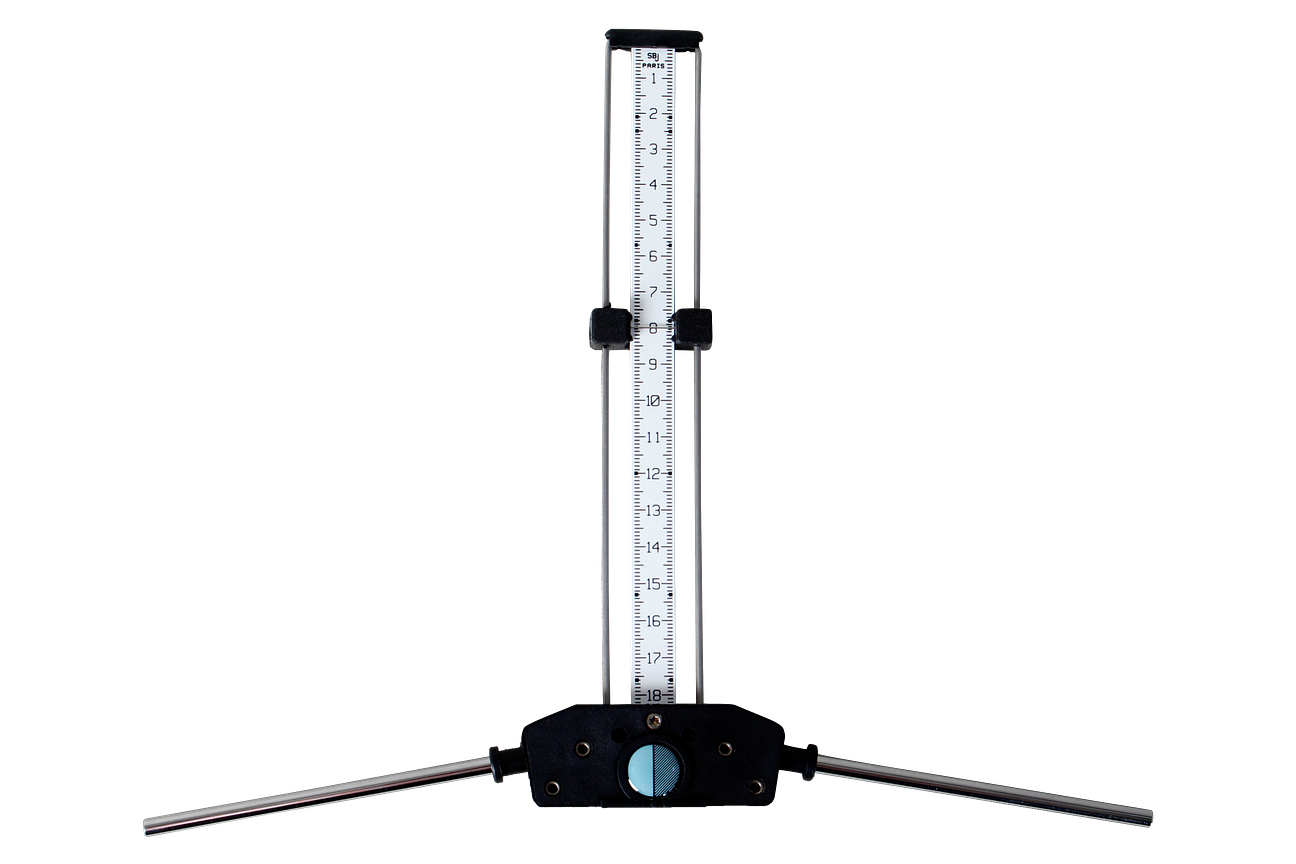
Image: a Lecher’s antenna.
Someone introduced me to Lecher’s antenna this weekend. I don’t know exactly what it is, or how it works, how it was conceived of, designed or built or what purpose it was intended to fulfil. But there is a conviction held by those who use it and on whom it is used that borders on belief. The device’s abilities are held in awe and wonderment. People say it works, but can’t, or won’t, reveal how it works or what practical use its results have. There is an aura of mystery around it.
Take a bicycle and a teletransporter, like the one they thought up in the TV series Star Trek. The engineer pulls some levers and people are de-atomised on the transporter pads and are transported to wherever the thing sends them, like the surface of a planet. I often wondered why it could not transport them to the position one pace behind a Klingon, where, armed with a hatchet, they could take the enemy out without them even knowing they were there. The technology, we were told, was that the atoms of the individual being transported—the transportee, I suppose—were separated from one another, albeit the configuration was remembered by the device, which then beamed the atoms to the destination, whereupon they were reassembled in the remembered configuration. That’s how it worked. Or how it was supposed to work. I don’t know but I don’t think anyone ever built a teletransporter that actually functioned in that manner, however. Even though we could rationally appreciate how the teletransporter worked, no one ever believed that there was such a device that worked in the manner described. We had rational understanding, without belief.
Now, if you remove the cotter pin (which they used to use in bicycle cranks) from an old bicycle, you may step onto the bicycle, which you see propped up against a fence, in order to pop off to the grocery to buy some beans. When you step on the pedal, it will spin fruitlessly, and it will not drive the chain, and so the bicycle will remain stationary. All of this assumes you know how a bicycle works or even that turning the crank on a bicycle will propel the machine and its rider forwards, even if you don’t actually know the intricacies of how the chain drive with its ratchets and pedals actually functions. You press down on the pedal and off you shoot. But not if the cotter pin’s been removed. A cotter pin is to a bike what a rotor is to a distributor cap. I.e. they’re both obsolete these days.
Now, the first time someone rode down the street on a bicycle, people will have stared in wonderment and asked themselves, “Ach, meine Gute! Wie um Himmels Willen funktioniert so ein Ding?”, or some such, because they would have been in Germany. Looking at someone astride one of these:
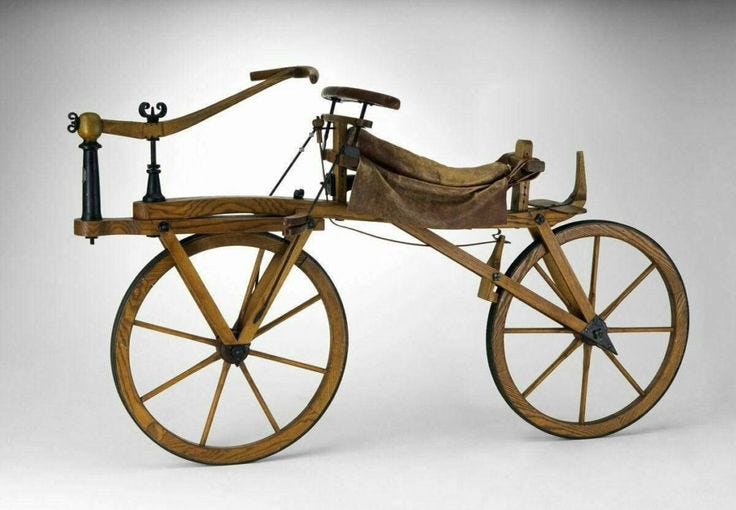
Image: an early Laufmaschine, the ancestor of the speed-elec.
And, when you see it as well, you may also be wondering how on earth such a thing works. Your rational side will kick in: the scientific investigation section of your brain will whirr into action as you reason the different parts, their movements and how the whole thing doesn’t land you in a almighty heap at the bottom of the hill. (Spoiler: it generally did.)
So, there we have three devices. One, the Star Trek teletransporter, which we can rationalise, but don’t believe in. Two, the German Laufmaschine, which we cannot believe in until we have rationalised it. A third example might be the magnetic tape recorder. I had one when I was a boy and it’s the same principle as applies to Walkmans, cassette tapes. How on earth does Stravinsky get from the sound box of a violin onto a strip of metal-and-plastic tape? Well, who cares, as long as I can listen to Stravinsky. And that’s pretty much the attitude we have to most technology: someone, somewhere understands how it works, and understood how it would work when it was designed and built, and we trust that the effects the device produces are the effects desired when the device was designed and do not include undesired effects that were not built into its design. Like crashing at the foot of a hill.
The effects of a Lecher’s antenna are unusual, to say the least. It is held, or touched, by the subject and its effect is to provide information about the subject to the operator of the device, or the person carrying out the procedure (since I’m not sure what exactly the right verb is in such a case). I certainly mean no disdain, unlike when James Stewart (Captain Towns, pilot), wonders aloud to Hardy Kruger (Heinrich Dorfmann, aircraft designer), in the 1965 film The Flight of the Phoenix, whether this thing would ever get off the ground, to which Kruger replies, as a designer talking to a pilot, that it’s not a thing, it’s an aeroplane. While the scene is demonstrative of the tensions between the man who has caused the accident resulting in his aircraft and its cargo and passengers being stranded in a desert 150 miles from Benghazi and the man who believes he can get them out of the hapless position in which they find themselves consequent upon said accident, it does throw up a scientific conundrum: the aeroplane that Dorfmann designs using parts salvaged from the wreck of the crashed machine is only an aeroplane if it gets off the ground. If you design something that cannot get off the ground, it is not, by definition, an aeroplane any more than my fountain pen is. So, the generic term thing is all the thing is until it actually flies. What makes the thing a thing in the view of Captain Towns is his scepticism as to whether it can fly at all. And what makes the thing an aeroplane in the view of Herrn Dorfmann is his conviction that it will indeed fly, exactly as he has designed it to.
With this in mind, let me return to the Lecher’s antenna, which tells you what the subject’s emotional state is, and then aids you in resolving that emotional state into a less discordant emotional state. It seemingly does a survey of the organs of the body and reveals disquietudes to the operator, which, by reference to certain manuals and books of interpretation, allow the operator to propose a diagnosis and then recommend a therapy. Insofar, it is not unlike a doctor’s stethoscope. Except that it’s in fact very different from a doctor’s stethoscope, because of the absence of that one word: doctor.
Naturopathy, (faith) healing, homoeopathy and other forms of treatment that purportedly (or actually, depending on your viewpoint) procure health improvements reside in the medical grey zone between utter and absolute codswallop, on the one hand (alongside Star Trek teletransporters), and proven medical practice, on the other. What convinces in terms of these alternative forms of curing is ultimately whether they work or not. I had eczema in my ear for ten years. One day my sister-in-law who practises homoeopathy noticed I was constantly dabbing my ear with a handkerchief. “It’s something I have,” I said, “I can’t do anything about it.” She gave me some homoeopathy—an interview and some therapeutic sugar pills—and in five days the eczema was gone and has never returned. I believe in homoeopathy not because I know how it functions but because it functions.
A friend of mine will go into hospital on 11 June for back surgery and the risks involved are fairly high. I don’t know if there is a homoeopathic cure for his ailment, and he would likely dismiss it as improbable if there were. But he knows there is no 100 per cent guarantee that his surgery will succeed. He hopes it will, and so do I: maybe I should pray to God for him.
Spiritual healers have succeeded in remedying worse ailments than back pain: supposedly incurable cases of cancer. Healer Matthew Manning maintains that any form of healing, whether it comes from the medical professions or from a spiritual healer or homoeopathy, cannot fully succeed with an utterly supine patient: the patient must want to be cured, and is best advised to work with the healer to achieve an optimum result. Even sceptics admit of strange coincidences, where the dying hold on to life until some goal has been achieved, such as seeing a certain person or reaching a certain date. That will to extend life to a moment of significance in the case of the dying can be applied by the sick living to lend a hand in their own recovery from illness. It really is mind over matter: Manning himself in his book One Foot In The Stars talks of those who suffer as being far more than what the medical professions regard as they might a broken-down radio. No radio can fix itself: it needs an engineer to do all the repair work. Not so the individual patient: they are perfectly capable of aiding in their own return to health and, while that may not be a definitive element to any cure, let’s say its presence can do no harm.
So, how does a Lecher’s antenna work? Those of us unfamiliar with such a device will fall into three categories: those whose scepticism will prevail until such point as our powers of reason have led us to the conclusion that the device does precisely what it is designed to do, on the basis of powers and forces in which we place enough faith to believe in the device’s probity; then there are those who believe in the device because the operator says it works the way it supposedly works and the subject is keen for it to work—like a Walkman playing Stravinsky; and there are those who will never place any credence in the device, because they have built a wall around themselves, behind which they refuse to accept any form of healing that cannot be scientifically proved—whereby science itself is defined restrictively.
Those of us, on the other hand, who are familiar with such a device will already know into which camp we fall. Our choice may be influenced by peer pressure, by so-called research; yet, if you look hard enough, there is research material available to prove that the Earth is flat just as there is to prove that it’s round. What the choice ultimately boils down to is the readiness or otherwise to make a leap of faith; and those who embrace such leaps in some quarters of their life, and yet resist them in others, may well wish to ask themselves why they draw such distinctions.