
Who killed JFK?
You mean legally, or morally?

With all the hoo-ha that has pursued us through history since that fateful day in Dallas, Texas in 1963 when the life of John Fitzgerald Kennedy was ended in a trice, the underlying question has been Who killed JFK? And behind that seemingly straightforward interrogative lie two less-easily answered, albeit similarly phrased questions:
Who shot JFK? and
Who was guilty of JFK’s murder?
Who is guilty of JFK’s murder … ? Legally, and it is the law that determines guilt in terms of that law, there are two manifestly innocent parties in all the drama that surrounded the shooting. One of them is Lee Harvey Oswald; the other is Jack Ruby.
The Warren Commission, set up to investigate the shooting of Mr Kennedy, concluded beyond question that the president was killed by a lone gunman; that there was no conspiracy and there was no plot. Lee Harvey Oswald killed John Fitzgerald Kennedy with a single bullet, which, miraculously, contrived to cause no fewer than seven bodily wounds to two different individuals (the president and John Connally, the Governor of the State of Texas, who survived the event) and which was subsequently photographed in its eventual, near-pristine, state, having been found on Mr Kennedy’s stretcher.
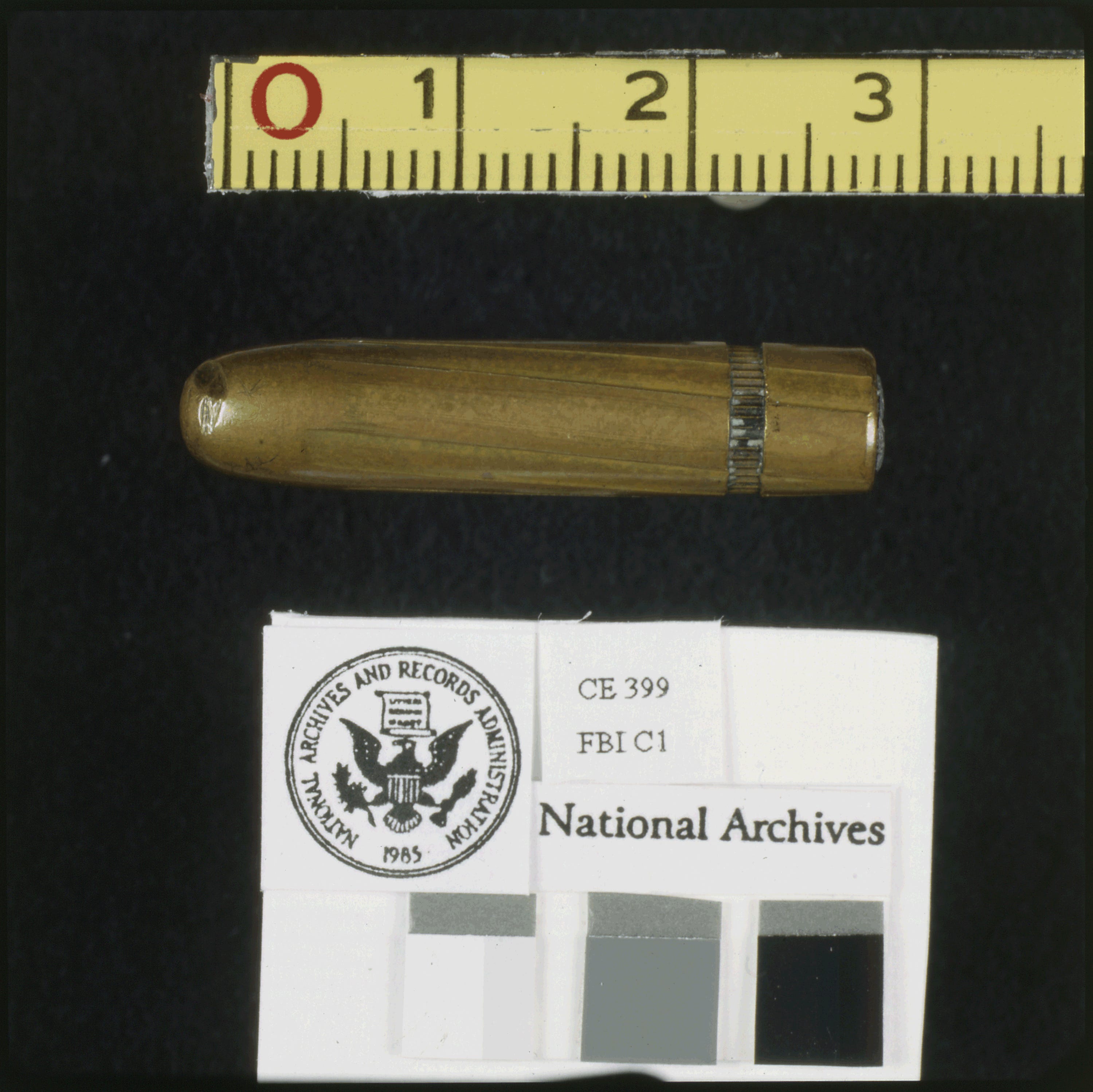
Image: the bullet that killed JFK and wounded Texas Governor John Connally.
However, Lee Harvey Oswald, who protested his innocence to police in the aftermath of the shooting (he swore he had been set up as a patsy), died an innocent man. He was never arraigned before a court of law and tried by a jury of his peers and, despite the findings of the Warren Commission, they do not amount to a holding in law of Oswald’s guilt. You cannot try the dead.
As is well known, Lee Harvey Oswald died after being shot by the mafia gangster Jack Ruby as he was being escorted out of a Dallas police station. Now, Ruby was tried and found guilty of the murder of Oswald, but he appealed his conviction, pending which he was hospitalised, where he just happened to die before his appeal could be heard. There being no final judgment on Mr Ruby, therefore, he too died an innocent man.
So, legally, we don’t know who killed John F. Kennedy, and we don’t know who killed the putative killer of John F. Kennedy. And that was supposed, in 1964, the year the Warren Commission was disbanded, to be that.
Of course, that hasn’t been that at all. Speculation has been rife and nothing is quite such a breeding ground for speculation as speculation itself. Academic and activist Norman Finkelstein, probably the world’s greatest authority on the Gaza question, says that, of the thousands of books written about the Kennedy assassination, he’s read every last one. And nowhere in any of those tomes is there the slightest suggestion that Kennedy was killed on the orders of Israel. So, it is with some incredulity that he now hears rumours that Kennedy was done in on the orders of the Mossad. His conclusion: Israel and its Mossad are guilty of a good many crimes and wrongs, but evidence is yet scant to suggest they are guilty of every last one of those they are accused of. And, until the evidence shall be forthcoming, his stance on accusations of Israeli involvement in JFK’s demise is to treat them with derision.
That, in some measure, is the assurance that law offers: it sets out its criteria, which, if fulfilled, result in certain processes and procedures and, if not, don’t. The law is therefore a much more limiting set of rules than a moral code is. Whilst there may be a generally accepted set of morals that apply to us all, there will always be outliers among us who deem one or another aspect to be inapplicable. No sex before marriage is a fine rule if that is what you want to follow. But all the law says is that sex shall not be engaged in without consent. Marriage is irrelevant to the act of sex, in terms of the law. But it’s long since been an accepted practice in some strata of society that, while a girl may not have sex before marriage, boys are expected to sow their wild oats. So, the pre-condition of being married is a moral consideration of flexible application, according to the sex to which it applies, if you follow what I mean. And, once the marriage is consummated, the idea really is that sex after marriage should likewise be constrained within the limits of the matrimonial bed. In the law of divorce, the moral considerations surrounding sex during marriage impinge on the parties’ legal rights and prerogatives. If you come home to find your husband copulating with your best friend on the dining room table, as happened to an acquaintance of mine, it is not your legal prerogative to round up the children and abandon the matrimonial home. Not here, at any rate, and not then. That may come over as a surprise to you, as it did, at the time, to my acquaintance. She was the one who had broken up the marriage, not her copulating husband.
This all makes for a right old mish-mash. Murder, I think we can pretty much universally agree, is a matter for the law and the courts. But what about sending-offs from football pitches, such as with the recent case of the American player Falorin Balogun? Personally, I agree with pundit Gary Lineker’s assessment of that football World Cup situation: whether FIFA or the president of the U.S. was the main mover in reinstating the man’s availability for the match against Belgium, the U.S. team should simply have not fielded him, in order thereby to reinstate the deemed fairness that accompanies a referee’s decision. One might say, thereby levelling the playing field. However, legally, there is nothing whatsoever to complain about with regard to Mr Balogun’s release from the red card decision. What nobody seems to be raising is the question of whether the U.S.’s game against Bosnia and Herzegovina, in which the red card had been produced, shouldn’t as a result be replayed? One can argue that the legal disadvantage of losing a star player and still achieving a win against Bosnia means the result should stand; one might likewise argue that the hullabaloo surrounding rescission of that red card didn’t in the end secure the U.S.’s defeat against Belgium, for want of their ability to concentrate on what the game was actually about: football.
Legally, Lee Harvey Oswald was innocent. What confirms us in that view is the fact that, despite his arrest, his acting as a sole assailant runs so counter to our intuition that we are almost bound to speculate that others were involved. Jack Ruby was innocent, legally, despite television cameras having recorded the murder for which he was tried. The speculation we embark upon by seeing Oswald murdered on TV before our very eyes is no less than that triggered by Ruby’s death in hospital whilst awaiting his appeal.
Jimmy Savile, who was guilty of a litany of sexual offences against minors, also died an innocent man. Despite numerous rumours and nods and winks among those who strongly suspected or blatantly knew, Savile was never arraigned and tried by a jury of his peers for the crimes he (purportedly) committed. So, where does that leave us, the observers of these matters? Does it make us barrack-room lawyers, tap-room pundits? Do we know where others don’t, where others rely steadfastly on the workings of Dame Justice to determine definitively where right and wrong lie? We have the moral fast-track to the holy grail of truth; the law is simply an ass?
John Connally, who avoided death that day whilst motoring through Dealey Plaza, Dallas, in that he twisted his head so that the bullet that entered him (three times) missed his heart and injured his lung instead, went on to speechify about how God had preserved him that day: he had been elected by God to serve a purpose, and, on that campaign thread, he would go on to win the governorship of the State again in 1964. I don’t know if it was God’s purpose that he should also eventually turn away from the Democratic party to the Republican party, and he’s no longer with us to ask. I know (I can confide in you) that my life has been saved by Providence on at least three occasions and, whilst I have surmised, after long reflection, why my life was preserved, I can never know precisely. Except I can can tell you one thing: reflect for as long as you will, the conclusion at which you arrive as being the reason for which fate’s blow missed you, whether as sole survivor of an air crash, or as one of its most heroic victims, if you seek the moral underpinning of such eventualities, you will be mistaken. Trusting your moral compass in assessing the rights and wrongs of others is in and of itself a fallacious exercise. Your moral compass is calibrated to your own north pole; everyone’s lies slightly askew from everyone else’s. No two moral compasses align. So, before we moralise, we must first bear that fact in mind.
But, what then, of law? Does law not illuminate a truer path than morals do? “The law,” says Sir Thomas More to Thomas Cromwell, his accuser, in A Man For All Seasons, “is not a ‘light’ for you or any man to see by; the law is not an instrument of any kind. The law is a causeway upon which so long as he keeps to it a citizen may walk safely.” It is not illegal for Donald Trump to have prevailed upon FIFA to rescind Balogun’s red card. But, then again, what is illegal and what is legal in Trump’s system? One that parades the consequences of not cooperating with its meanderings through law as a penalty for that failure, notwithstanding the legality of the manner in which the man’s wishes are expressed? Where, in that constellation, is the certainty of law?
Thomas More was wrong, as he himself would discover. The law is not a causeway marking out a safe path for the citizen. The law contains twists and turns that unwary citizens may only become cognisant of by actually erring from the very causeway he thought was so secure. It was precisely that which caused More to be executed: he resolved his moral stance in terms of the law as written; and then they changed the law. And morals can be changed no less easily than can laws, and the interpretations of laws. How long before tariffs are imposed on Belgium? quipped one wag in response to the nation’s 4-1 victory over the U.S. on Monday. I think we can say three things of Falorin Balogun’s red card:
whether it was deserved in the first place was a matter for the referee and no one else;
its rescission was something Balogun had nothing to do with;
the president’s intervention had nothing to do with Balogun’s ethnic background;
if Balogun’s ethnic background had been a decisive factor, the president would not have intervened.
One is left wondering at how the president intervenes to restore the playability of a footballer whose ethnicity is in other quarters the object of the president’s own outrageous policy, whereby he leaves a trail of destruction for FIFA, UEFA, Infantino, not to mention Balogun and the entire U.S. squad themselves, to clear up, whilst swiftly moving on to the next matter for his attention. It is itself a matter that will draw the attention of the whole world for many years to come; that, at least we can be sure of.
The difference between guilt and shame is that guilt is imposed under the law by others; and shame is imposed under moral considerations, by the individual themselves. Breaking the law can, of course, induce moral repentance, and therefore shame. But, conversely, a breach of morals does not result in a guilty verdict in a court of law. That, simply put, is the difference. We may argue the correctness or otherwise of a court’s ruling, of the rules of procedure by which evidence is highlighted, occluded, disregarded or covered up. But our third-party judgment of a legal decision is always prefaced with the words on the basis of the evidence as adduced. In the moral sphere, however, there is no evidence. The moral judgment of another will always be wrong, because it will equate to arraigning a prisoner accused of a crime in one country under the laws of a quite different country. Their laws may overlap or concur on certain aspects, but they will never align. And moral considerations will never align either. The religious man is of one conviction: that judgment of him will come not from mankind but from his god. If there are those among us who would wish to enforce moral rectitude among their fellow men, then let them pass laws setting forth the causeway upon which a citizen may safely tread; and let them tread upon it themselves. Then, and only then, will morals be enforced. Until then, each individual must enforce their morals upon themselves; which, one would have thought, would be the easier of the two tasks.
Let me conclude with the following (edited) note, which I put up recently in relation to an article about Michael Jackson, the pop singer.
For millennia, paedophilia was a moral outrage: there were those who had a moral stance that sought to protect the future, the child, as an integral part of community (not the nuclear family—that would not come until much later, post-war); and, on the other hand, there were those who had a selfish bent: no one would ever prevent them from taking what they wanted. That is the substance of sex crimes. They differ from crimes like theft and murder because what drives perpetrators to the offence is their sense of entitlement. Rape and child sex are far more about power, psychopathy.
Obviously, a paedophile will not wantonly steal chocolate bars as an outlet for his sense of power, so there is an underlying desire. The moral consideration in the mind of a potential paedophile, which prevents them from actually committing the act, is less that they repress the desire to take carnal pleasure with a minor, and more the fact that they cannot bring themselves to exercise the power that taking such pleasures would entail. It is not the sex that they deny themselves; it is that they cannot attain the level of psychopathy that the act demands.
The psychopathy that has led to the Gaza genocide, and that which led to the Circassian genocide in the 19th century, and that which attended certain atrocities in Ukraine during the current war there, is pumped up and spoon fed to the agents egged on to commit these acts: they are brainwashed, if they do not possess an in-bred inclination to commit them. A regular conscript, called up to fight his nation’s war, is supposed to be capable of opening fire on the enemy in the name of king and country: he or she does so to preserve the righteousness of their nation and its people. When they start to enjoy the act for its own sake, then, like T. E. Lawrence, they start to question their own morality and to abhor themselves.
When the self-reasoning with oneself turns towards a kind of justification for the act committed, and even to relishing it, like IDF soldiers parading their cruelty for the enjoyment of Facebook subscribers, then psychopathy makes its entry: you switch from defining your role and place in society to instead defining the role and place that society plays in you. What you do and take from society is based no longer on society’s acquiescence in your so acting, but rather you take from society what you please, and society’s acquiescence assumes a subordinated role. The paedophile’s desire is to do precisely what is proscribed. I can do whatever I want, and that is what nobody else would dare do. It’s not, in the end, vastly unlike the driving power behind extreme sports.
In the moral dichotomy, there are two camps: those who are morally against the act, and those who are morally for it and, in extreme cases, those who are morally for something cannot see what the big problem is: like bribery, or smoking, or breaking the speed limit. That was essentially how paedophilia was regulated, for centuries. Then came the law.
The offence moved out of the moral sphere and into the legal one, and to great fanfare no less: almost like some IPO of a nationalised industry. Till that point, there were two camps: the morally for and the morally against. Now, with the law, there are three camps. They are: the law-abiding; the criminal; and the criminally immune.
You can hold a moral reprobate in disdain and it costs you nothing to do so—you can speak out against them, like a preacher in a pulpit. But law introduces punishments, and they have to be sought through the courts. The threat of blackmail in such a case gets turned topsy-turvy, in fact—the ordinary criminal miscreant, whose act would potentially see him prosecuted, receives a blackmailer’s demand for money, in order to smother the evidence. But, for the immune, the boot is on the other foot: the immune pay for non-prosecution, and add to that a threat of career consequences for anyone who will not accept such payment. Perhaps an inspiring example of this is the recent beatification of Floribert Bwana Chui, a Congolese customs officer who refused a bribe and was murdered as a consequence—the first African Christian martyr to stand up to corruption.
A graphic example of the three-camp system that the law institutes is Partygate during the Covid pandemic. They passed a law saying you could not gather socially. Most people were law-abiding; some broke the law and were even caught and fined for breaking the curfew. But the UK prime minister held parties. Because he considered himself criminally immune—and despite being fined and hounded from office, probably still does. Now, criminal immunity is not a reason to broadcast your crimes from the rooftops—that’s something of which the Epstein class are keenly aware. But it is still majorly possible to control any exposure through corridors of power. With the law-abiding and the criminally immune thus dealt with, that leaves the question of what to do about the criminal.
Well, they are the key to the whole thing. You can’t pass a law against something that people just don’t do. So people need to get caught. And that is what a lot of the Internet crime detection is all about: catching the low-hanging fruit. The Internet is rife with stories about child sex images being available—free of charge, even. The Australian police operated such a site as a honey pot, a little like the Black Panthers activist group in Oakland were infiltrated by government and police operatives, who organised all the violence. On the police child sex site, images cost nothing. Well, they do say that if the product is free, then you are the product. And I suspect that was so that incautious guilty parties could be clasped in handcuffs and paraded before the baying public by self-satisfied police officers who used the successes they booked to secure greater future police funding. And if that was not so, then what other reason could there be for offering free product?
Some years ago, at a zoo in Germany, I was picnicking with my in-laws when I saw a little girl crying. She had lost her mummy. My heart went out to her and I pointed her out to my mother-in-law, saying I would go to her. “No,” Gabi replied, “I’ll go. You’re a man.” That’s how bad it is: a warm-hearted man cannot console a little girl without being suspected of nefarious motives. I can’t definitively judge Michael Jackson, but his wealth can perhaps be viewed as one of two things:
the reason people thought they could embarrass him into parting with it without any substantive ground for doing so; or
the resource with which he was able to practise evil deeds undetected.
So, which was it? Was he a child who never truly grew up, and therefore sought out the company of fellow children? Or was he an adult who’d never known the innocence of childhood in the first place, and who sought out children as an object for the exercise of his power?
The thing is, I never associated him with the idea of a psychopath.
In case you missed them:
Breaking bad silence

There is much talk these days about the freedom of speech, the freedom to say what you think, and the freedom to stop others saying what they think. As far as I can glean, there is nothing stopping people talking about Jeffrey Epstein. It’s just that some people think that other people have inexplicably stopped talking about Jeffrey Epstein. Which shows…
Moses and the Ten Polite Requests

Bolted to the outside wall of my home is a rather heavy reproduction of a sign the likes of which would at one time in the dim and distant past have graced some location on the Lancashire and Yorkshire Railway. It reads: Notice. Any person who shall not shut and fasten this gate after passing through it is liable to a penalty not exceeding forty shillin…
On the American vice-presidency

Now don’t get excited, but I’m about to contrast the president of the United States of America with the president of Iran (and the king of Nepal). Not the individuals concerned, but simply the offices. Please do NOT flame me with comments about personalities.
Unleash the power of the Epstein files

Image: 21 May: the Circassian Day of Mourning. An annual remembrance march of the Circassian genocide by the Circassian diaspora in Turkey.