
Does it matter if your murderer laughs as he kills you?
Table manners, rugby and international law

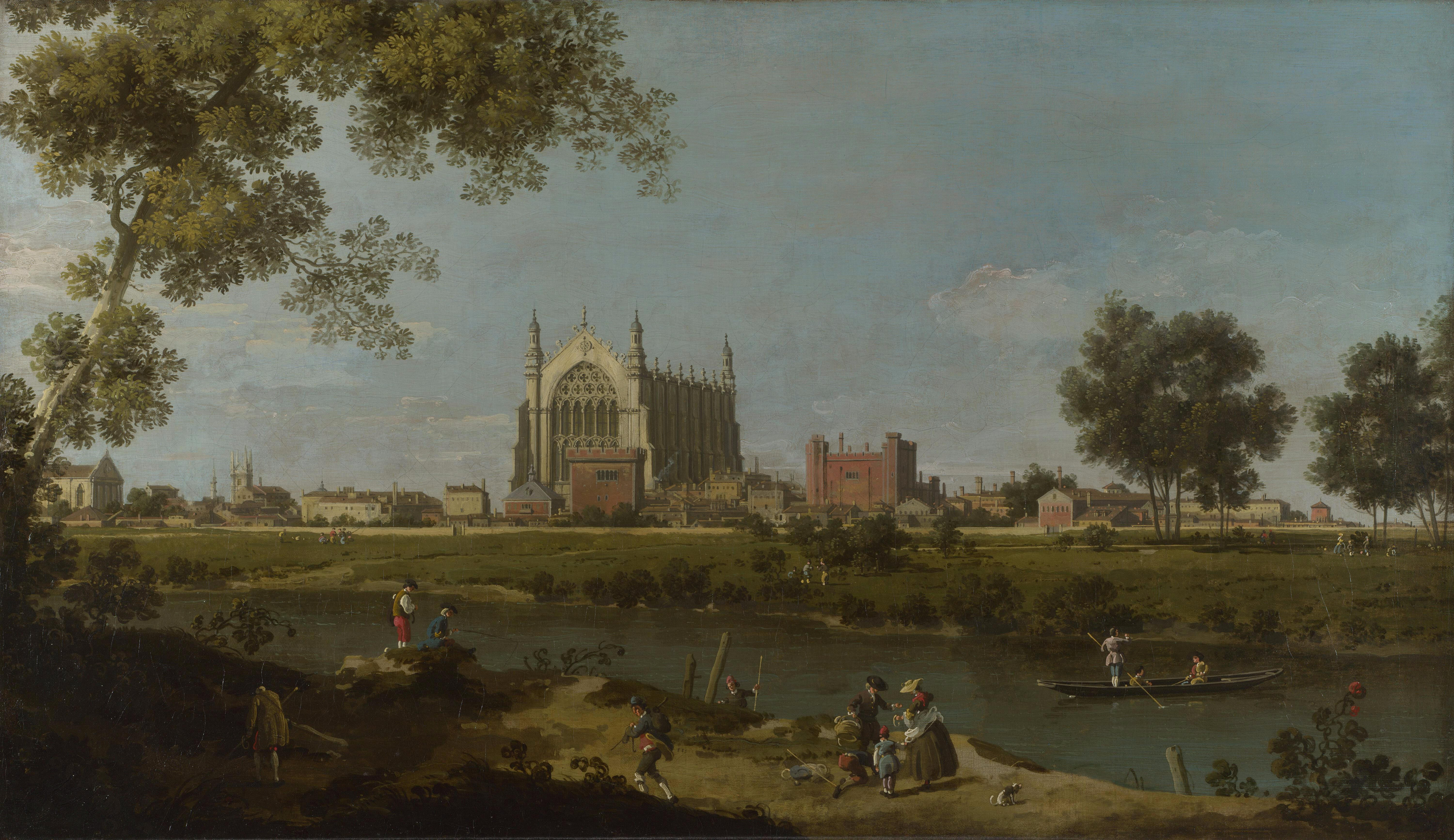
Image: Eton College as painted by Canaletto in 1754.1
My father used to say that rugby is a ruffian’s sport played by gentlemen, and that football is a gentleman’s sport played by ruffians. The idea was that, in rugby, once Webb Ellis, its putative inventor, had debased himself and Rugby School by picking up the ball with his hands (like a ruffian), play then continued according to the most exacting standards of honour and probity. Football, on the other hand, is a street sport, and therefore by its very nature the sport preferred by the man in the street. It predated rugby but is preferred in the concreted surfaces of Rio’s favelas and the East End of London because, unlike rugby, it shouldn’t ordinarily entail the player coming into contact with the ground, other than with his or her feet. The reader may wish to contemplate in how far both these games are now ruffian’s games played by ruffians: at the amateur level, there was always a degree of jiggery-pokery and pulling and shoving when it was thought the ref wasn’t looking, or was, but happened to be blind. Now, to add to that, is the prospect that he’s bent.
I remember a sevens game of rugby at school, a format which has the added advantage that the referee only has to keep an eye on 14 players instead of the usual 30, in which, after one particularly scrappy maul, the referee said to one of the opposite side’s players in barely a whisper, “Get off.” That was the lad being sent off the field of play for a transgression of the rules. It took us a second or two to realise what the referee was doing, it was all done so calmly and without theatre and show. There was no protest. The boy turned tail, a bit between his legs, and exited the field. He knew why, the referee knew why, and we had a game to finish.
In those days, the prerogative of a referee to dismiss a player from the field of play was much greater than it now is. The aim now is to ensure fair application of the rules when they get broken. The aim of the old system was to ensure the rules never got broken in the first place.
They say that the Battle of Waterloo was won on the playing fields of Eton, the famous boys’ school near Windsor. If they were to say it about a battle today, I’d be more sceptical, but in 1815 I reckon there was a good chance that the coordination required in sport could translate to the command of a battalion if necessary. But I can’t comment in detail, for I did not attend Eton College. I was not an outstanding player of the game of rugby. I played my part, but I did make it my job to at least study the rules and, on the odd occasion when I ran the line, apply them. My overwhelming memory of school rugby was that the rules mattered, were respected, and were played to. I suspect that it’s these principles, as applied at Eton, that might have been a contributory factor in the victory at Waterloo.
When my older brother was playing, before my time, he was a member of the first XV and one Saturday they had a fixture at home against another, visiting school. The visitors were not as good as his team, and within seconds, his side had scored a try. It was swiftly followed by another, and another, and another. The final score as the game ended was 50-nil.
On the Monday, at school assembly, as was usual, the headmaster read out the results of the weekend’s sports fixtures for those boys who had not attended or not yet heard. It was an opportunity, besides pure information, to accord congratulations to the teams that had won, and offer commiserations to those who had lost. So, you can imagine that the players who had come off with such a grand 50-nil scoreline on the Saturday were preparing to preen themselves. What followed was not what they were expecting.
Being a home game, the headmaster knew what he was speaking about: he had witnessed it himself. The 50 points amassed over the game’s 80 minutes had not simply been clocked up like some century on a summer’s day of cricket. Once it had become clear that they were the superior team and that the opposition offered as good as no resistance, the home side started to play with a sense of jubilation and an attitude of derision towards their opponents, who were only too aware of their failings, but nevertheless had to see the game out: only in chess can you concede.
The headmaster finished with a phrase that left the victors hanging their heads in shame and, when the tale was told to me, the person who told it was not of the same view as the man who spoke those words. Moreover, it may well be that you, in reading this account, will divide into two camps: those who take the headmaster’s view and endorse it, not only for the game of rugby, but for wider application as well. And those who see no place for such a sentiment as his words expressed.
He said, “You proved you were the better side. There was no need to humiliate them.” And, with that, he made it plain that, to his mind, victory carries with it a moral responsibility.
His view was that, while they were indeed better and they had indeed won, they had not won with a spirit of mind that befitted the school’s traditions. In other words, such jubilation was out of place (and, furthermore, would likely not have won the Battle of Waterloo). Those who took exception to his words were more of the view that winning is winning and how it’s achieved is irrelevant. And if you are the better side, then you should play as that better side and score the points that are available with the opposition that is there.
Both views have their merits: perhaps if the winners had been less offhand, shown more respect for the efforts of the opponents, they could have won with grace. The scoreline might have been the same, but they would have conducted themselves differently in achieving it. On the other hand, is it that important how you lose?
The rules of international law, as set down in conventions like the Geneva Convention, the Genocide Convention, the United Nations Charter, the Rome Statute and other instruments of law, place obstacles in the path of those who would win by any means. They don’t especially concern matters such as jubilation, but they do impose a regime that requires anyone who wishes to achieve victory in an international dispute to do so according to those rules, the rules of the game, if you like.
They can probably be best compared to table manners. You don’t need table manners to eat, but what table manners do is pace the ingestion of nourishment so that the eater is not tempted to over indulge. We could abandon table manners and just tell people to dig in with their hands, to stuff their faces with all the goodies and wipe their mouths on their sleeves. But people generally don’t eat in this manner, for two reasons.
First, even if everyone likes to pig out every now and then, over-indulgence as a habit gets you to the point where it just makes you sick. Where the mere thought of eating makes you retch. You start to yearn for table manners because the eat-all-you-can free-for-all eventually pales, and you realise that, fun though it was for a while, we are just like dogs: we are happiest when we’re disciplined.
Second, even in the lowest circles, eating is still ceremonial in nature. People pride themselves on little touches that add finesse to a table, especially on special occasions like festive holidays or family get-togethers. Linen napkins, cutlery used from the outside to the inside, the correct shape of champagne glass, one salt cellar per two guests. But it is regarded as bad form to reach across in front of your neighbour. You must ask if they’d kindly pass the bread rolls. Silver service waiters will know to serve to the right, remove from the left. But one thing is an absolute no-no at the best of dinner parties: it is very much frowned upon, and pretty much guaranteed to get you blackballed from all future dinners, if you shoot the other guests.
However, infra dig and all that as it is to shoot people at the dinner table, if you just happened to get shot between the amuse-geule and the hors d’œuvre, does it especially matter if they’re laughing as they do it? I suppose not, if you’re the person getting shot. But it matters a hell of a lot to the onlookers; some of them will love your killer for it, and some will despise him. But no one will be unmoved by the fact that he laughed.
The no-shooting-other-guests rule only applies, of course, at the dinner table. Anywhere else, you may kill them will glee. Jubilation, even. Because although the rules of international law may look like the rules of Debrett—detailed, exacting, but not technically enforceable—you are nowadays more likely to be sneered at for dripping soup down your shirt front than committing the mass killing of 59,000 civilians.
It happens. Territory changes hands by a series of manoeuvres that are somehow consigned to history. These moves from the past can give rise to arguments and discussions, but, in the end, done is done. We are where we are. You can’t invalidate an entire rugby game because someone got away with collapsing a scrum in the first half.
But that is not the question: historical is historical; now is now. It is how the parties conduct themselves now that will reflect on them, and how it will reflect on them is a product of whether you see the schoolmaster’s comments narrated above as valid or as detached from reality. That is ultimately a personal judgment by you of him, speaking as he did in the early 1970s, so, a long time ago. But, more than being your personal judgment, it will in fact say something about you. It will say something about your attitude towards the spirit in which a sport should be played, first of all. Second, it will say something about the importance you attach to the rules of international law, and to the lives of people who get killed in violation of those rules.
In sum, it will say something about how you view your world, my world and the world of others. Not so much about the things that people do, but the attitude and manner with which they do them: rejoicing in the misfortune of others; using superiority to humiliate an opponent. It will say something about your view of injustice as meted out to people who are of no consequence to you, as opposed to when it is meted out to you personally, and the extent to which injustice meted out to those unknown to us can end up having grave consequences for us ourselves, given the precedents that such treatment can establish.
I’m not entirely sure whether the upbringing that the boys used to receive at Eton College was expressly intended to allow its graduates to command armies successfully, but I reckon that the link was not coincidental. Eton College has always had that tradition of producing leaders of men. But that is no excuse for the rest of us who are not Etonians to not aspire likewise, even if the only people we lead are ourselves.
By Canaletto - https://www.nationalgallery.org.uk/paintings/canaletto-eton-college, Public Domain, https://commons.wikimedia.org/w/index.php?curid=148704.
Great essay on human life Graham. Obviously I agree with the headmaster, winning isn't everything. I recall parts of a poem from 80 years ago when I was in grammar school "Remember, in a certain sense, it takes a better man to lose." Wish I could remember the whole poem.
There was no need to humiliate them...