
Orwell meets Shakespeare
The Thought Police meet Bolingbroke

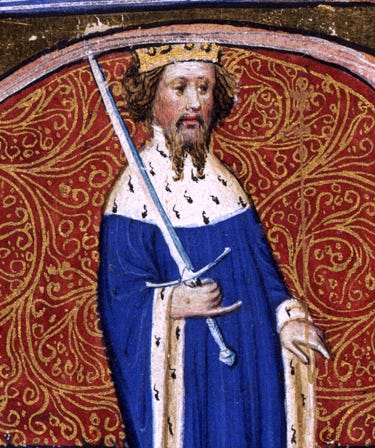
Image: Henry IV of England. Terrorist or freedom fighter?1
The definition of morality has been a discussion point between me and some followers recently. My position is that morality is personal, and cannot be imposed on others. It is a matter of the conscience, and ultimately a matter between the individual and his maker, though not all go to such … heights.
Below is a notes post that I put up yesterday concerning strange definitions (you can skip it if you already read it or have no interest). The present post extrapolates from it.
“Anarchy” is an emotive word, that conjures up a fixed, almost universally accepted idea of what it means. In this way, it is similar to phrases like “the rule of law”, “morality” and “terrorism”. Let me first disabuse you of the meanings of those latter terms. Then I will speak of anarchy.
Terrorism
Under the UK’s 1974 Prevention of Terrorism (Temporary Provisions) Act, passed in response to the Guildford and Birmingham pub bombings, many of the prosecutions following which were later overturned, sadly, because of the determination that the government manifested in wanting to “catch the perpetrators”, even if it could not be proved they were in fact perpetrators, terrorism is defined simply as “the use of violence in pursuit of political ends.”
Terrorism was proscribed before 1974 - it’s what got the leaders of the Easter Rising hanged - but what the 1974 act did was introduce a definition. It’s been amended multiple times as the government endeavours to bring more and more acts within its scope, because, once defined as terrorism, they get sanctioned in the same way. It’s a pigeonhole.
In the wake of the Southport riots, Keir Starmer made an astonishing declaration: that the government would introduce legislation to subsume within the definition of terrorism acts that are not founded in ideology. Yet a political end is an ideology. Starmer hijacked terrorism to make it “aggravated criminality” and thus imprison 84-year-old grandmothers who protest against genocide. It takes all consideration of negotiating a settlement with those who harbour political grievances out of its prevention. “We don’t negotiate with terrorists” gives terrorists only one path for their protest: violence.
Yet “terrorist” now says something to the general public that the general public is united in: bad people. Well, David Ben Gurion was a terrorist, Eamon De Valera as well. In fact, King Henry IV was a terrorist, and his successors are on the throne today.
Morality
“Immoral” means what you do that is not proscribed by law and that I find repugnant. Slamming drugs? I don’t find that immoral - what you do to your health is your affair. But it supports drugs cartels, you say. So does much of legitimate commerce - your income taxes go to buy fighter aircraft for Israel. Is that moral?
If I’m to take a moral stance on every last thing others do, I will get nowhere. I must restrict my morality to what I do, and so must they. The law is for all of us. Morality is for our own consciences. But, when you speak of morality, people think you speak of a set of standards inscribed in tablets of stone, which apply as much to you as they do to me. No, sorry, that is law, not morality. (I do recognise that shooting up drugs is generally proscribed by law, but it also carries moral overtones: if you see that as a technicality, substitute wearing a hat in church (if you’re a man), or not wearing a hat in church (if you’re a woman), driving a high-polluting car, or being a lobbyist).
Rule of law
“The rule of law”: is the law applied according to the law. When the law is not applied according to what the law says, you have no rule of law and, to a certain extent, nor do you have law and order. You have an arbitrary application of legal norms. Some people would call that “anarchy”, but it’s not. It’s tyranny. Because a central state is controlling how the law is applied. They just decide arbitrarily how to apply it instead of following its legal norms.
Anarchy
So, now we’ve established - I hope - that commonly understood terms can be easily misunderstood when their meaning is manipulated, let’s look at “anarchy”.
Anarchy is not where everyone shoots everyone else to grab their land or possessions. That’s confusion, the wild west, lawlessness.
But anarchy is not lawlessness. It is a state of mind in which the primordial consideration in dealings with others is cooperation, founded in the knowledge that the inability to cooperate will mean economic failure.
Instead of defence being assured by a state border and an army, defence is assured by a universal recognition of the need to cooperate. As the world currently is, this requires a sea change in thinking. People say it is counter-intuitive, but it worked for 300,000 years before we invented nation states and discovered what else you can do with gunpowder other than warding off evil spirits with fireworks.
After World War II, the readiness for cooperation was supreme across the world. The United Nations found applicants for membership galore, because they all had seen what a state of competition had led to. They thirsted for cooperation. In effect, they were willing to abandon their aspiration for aggression in exchange for a guarantee of safety, encapsulated in the United Nations Charter of 1948. That is nothing more and nothing less than what anarchy is, except it is based on human interaction instead of interaction between nation states.
Conclusion
The rule of law is still achievable, if we combat corruption and tyranny.
Morality has always been achievable and still is if we interrogate our consciences.
Terrorism has become so fraught with contradictions, it is quickly losing its meaning.
Returning to anarchy in its pure sense without the overtones of bias and prejudice is probably out of reach right now, other than on the miniscule scale of communes and kibbutzim, at least until catastrophe overcomes the human race and we are destined to reboot humanity from zero.
Others take a view that society can impose a standard of morality that enjoys general acceptance and should enjoy general adherence. There, I disagree, but this is no isolated, unrelated argument. It goes to the very heart of the more sinister developments in legislation in our modern age: the thought police.
If you subscribe to the view that morality is something to be imposed on others, and not just oneself, first of all you embark on a huge undertaking as regards your own personal conduct (which is no longer governed by your conscience, but by everyone else’s conscience, and vocal reprimands) but also as regards the constant interrogation you will engage in as regards the intentions of everyone else you encounter. That is the nub of morality: what you intend.
But it is precisely this aspect that goes to the heart of things like the Online Security Act and the definition of terrorism: the authorities—the thought police—impute to those who engage in certain ostensible acts an intention that is set down in statute. The thought police impose morality just as those in society who express such a view would wish to impose morality on others. The difference is that the authorities do so under force of law.
Terrorism is the use of violence towards political ends. So, how does it come that simply saying one backs the political aims of a certain organisation, without engaging in violence towards those ends, can be defined as terrorism? Terrorism has now been extended to “supporting those who engage in such violent acts” and peacefully protesting in favour of the same political ends as are sought by an organisation that pursues them as well, but using violent means, is now proscribed as an act of terrorism.
The notion of terrorism comes from the spread of terror among the general population, who don’t know when or where they will be safe from random, violent attack. But a peaceful protestor does not attack anyone. In fact, they draw attention to the cause (otherwise the protest is pointless) in an identified place at an identified time, so the random aspect is absent. They think in their thoughts that the political end is valid; they ask it to be considered by others, by giving voice to it. But the authorities have twisted the definition of terrorism so that just saying you think that a political end is valid is enough to lend support to it and promote the use of violence, whether any violence is used by you or not, because supporting someone who advocates violence is in the law’s opinion to support violence itself.
If I support any country, then I support violence, because all countries have armies, and will use armies if they are moved to do so, for civilian or international confrontations. All countries engage in the purchase and/or sale of arms: that is the promotion of violence. If a supposed terrorist organisation acquired arms, but did not shoot them, they would still be prosecuted. Equating nation states to terrorist organisations might be regarded as a silly position, and it would be a silly position if nation states did not now engage in action that starts to become tantamount to terrorism. If lawmakers are to bend definitions to meet their needs, then we must look at the definitions and apply them to all, including to lawmakers.
By revising our views on morality, however, to make it a personal confrontation between our intentions and our consciences, we restore logic to definitions like terrorism: if I think that a terrorist organisation is right in the claims that it lays before the government that denies them satisfaction, then I may say so in support of their reasoning, so long as I do so peacefully. And the government in question may deny my petition, so long as it does so peacefully as well, including without imprisoning me.
I support the political ends of Palestine Action. Were it to resort to military force to press home its political ends, that might be regarded as the same kind of force as was used against its members’ forefathers in 1948, or against them in 1967, or against them since 7 October 2023.
It might also be regarded as comparable to the acts of the Arab Revolt, which the United Kingdom supported with logistical support and arms during World War I. It might be regarded as similar to the uprising by Henry Bolingbroke against Richard II of England, whom he killed and whose crown he stole in 1399, and wore until he died in 1413, and passed to his son, Henry V, who went on to engage in heroic terrorist action in France to recover his French crown from Charles VI, king of that country.
Terrorism is just a pigeonhole: it does not define the validity of the political end that is pursued; it is merely a label applied by those who oppose it and, what’s more, who are not prepared to discuss it peacefully. Terrorism is a label applied by those who oppose peaceful discussion.
“Uneasy lies the head that wears a crown,” says Henry IV in the play of that name by Shakespeare. Uneasy lies the head that steals the crown, more like. And no head should lie uneasy that merely thinks the crown was stolen.
Especially when it was.
By The National Archives UK - Illumination of Henry IV, Public Domain, https://commons.wikimedia.org/w/index.php?curid=43746918.
Interesting. I'm an anarchist, and I spend a fair bit of time explaining there is a difference between anarchy and anarchism. Your definition of anarchy is my definition of anarchism, which might explain the problem! I take the view that I need to disabuse people of their mistaken belief that the two words mean the same, because that's what they do seem to believe. If the people you talk to can tell them apart, that's great. I wish I could say the same, but anarchy is used so freely in the press and media as a substitute for chaos, lack of control, incompetent government,
rioting etc that it is hard to distinguish its political/philosophical meaning from casual use. I've filed your post for future consideration - useful, thanks!