
Toppling memorials
But why are they put up in the first place?

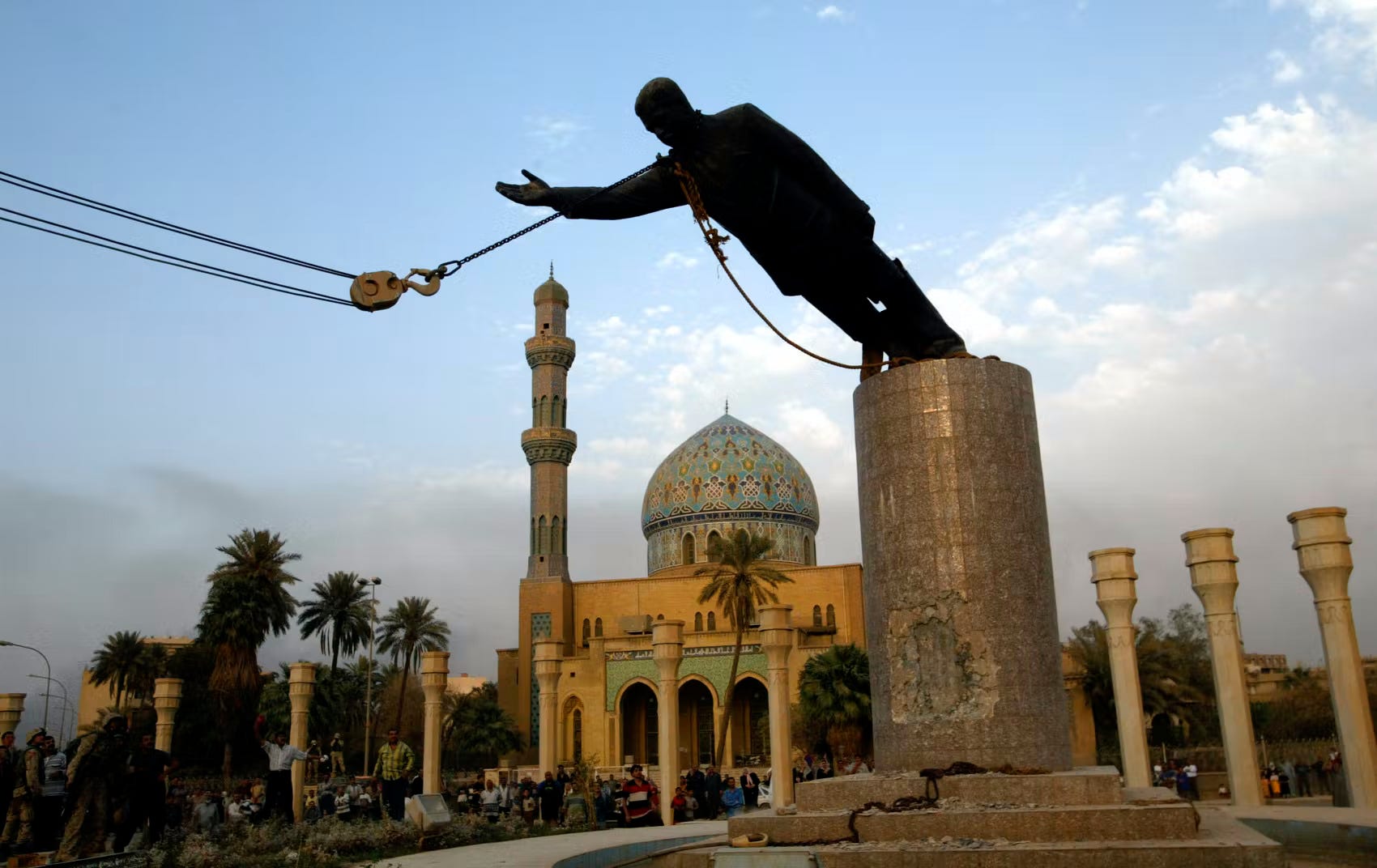
Image: Statue of Saddam Hussein in Firdos Square, Baghdad, being toppled by Iraqis shortly after the Coalition invasion of Iraq in 2003.1 I wonder whether there are many statues in Iraq today commemorating their invaders.
Some years ago, the Federal Prosecutor in Brussels commissioned me to translate some official documents into German. The matter concerned a headline case that had been reported across the world: the 2016 bombings at a metro station in Brussels and at its airport, just outside the city in Zaventem. It was not the first harrowing set of documents that I had translated for the Federal Prosecutor. I transcribed from a tape the experiences of Tutsi victims of the Rwandan genocide in 1994, and translated it and a large number of witness statements as part of Belgium’s endeavours to avenge the deaths of their UN peacekeeping troops, who’d been killed at the outset of the genocide. I had translated the medical reports on General Augusto Pinochet, in consultation with a panel of erudite medical professors, when Belgium sought to extradite the man from London, where he was undergoing medical treatment and refusing extradition on the grounds of ill health—ironically enough. I translated 2,000 pages of evidence against an American soldier who allegedly broke into a nursing home for the elderly in southern Belgium, climbed into the bed of one of the patients and raped her in the middle of the night, was disturbed by the night nurse and fled in his underpants, in which state he was arrested a few minutes later by the police in the middle of a nearby street, unable to explain what he was doing there or how he got there.
Translating these documents is supposed to be emotion-neutral: you translate the words on the page into words in the target language, and that is that. A sworn translator should never interpret the words they translate. That is a matter for the instance before which the translation is to be presented as an aid to understanding the source document: it is on that that such interpretation should normally be based, but can’t be due to the language barrier. The translator’s task is to breach that barrier, and no more. It is not their job to tell the relevant instance what things portend, mean, imply, can be understood as. We try to deal sensitively with clerical errors, such as spelling mistakes (you cannot wilfully translate “loose” as Dutch “los”, when what is clearly intended is “lose”, which is Dutch “verliezen”). Nevertheless, through the entire translation procedure, the translator does not remain an automaton, even if much translation work nowadays is precisely done by automatons. An official, certified translation is the one form of translation that should never be done by an automaton, by a machine, and yet it must produce a product that is as if it had been.
The shop where I work requires all comestibles to be labelled in Dutch, because the shop is in the Flemish Region. When they started up the process of affixing labels, bottles of still water, as opposed to the sparkling variety, were labelled as “nog steeds water”: water that had not meanwhile changed into something else; it was still water. At the weekend there, I was labelling tins of baked beans. The translation read “gebakken bonen”. “Boon” (plural “bonen”) is the correct word for a bean. And “gebakken” is the correct word for “baked”. The problem comes when you realise that baked beans are only called baked beans, but they are not baked. They are steamed. And that is different from baking. In fact “bakken” is classically used in everyday speech to mean “fry”, so that “gebakken bonen” translates back into English as “fried beans”, not as “baked beans”. “Bakken” does also mean “to bake”, but that is in the sense of an oven, and applies to things like bread, cakes and pizzas. But, because baked beans are not in fact baked, the question arises whether a translator should intervene en pleine connaissance de cause to translate baked beans as “gestoomde bonen”, which is what they are, as opposed to what English calls them. The same product sold in Belgian supermarkets is in fact called “tomatenbonen” (tomato beans) or “witte bonen in tomatensaus” (white beans in tomato sauce). I think the only time anyone would bake a bean is to make a flan case, but how far should the translator intervene in order to ensure understanding on the part of the reader?
My purpose here is to try to entertain you with a little bit of the tortuous aspects of my activity as a translator, but by extension to pose a more serious question: can we always take the origins of something presented to us in simple terms at face value, without further enquiry?
Today’s headline in the Belgian press concerns vandalism in the city centre carried out over the weekend to an installation that had been set up not far from the locus of one of the Islamic State attacks that occurred on 22 March 2016, in conjunction with which I had done those translations. I wasn’t immediately affected by the attacks, although an Argentinean friend of mine who was working as a check-in clerk at the airport was directly involved: “All of a sudden there was an explosion three check-in rows in front me. We all cowered down, and then there was another explosion three check-in rows behind me.” Rob was very annoyed: it took him a week to get his car out of the staff car park. But he’s pretty costeau, so he brushes it off as just one of those things.
My own involvement, reading the police interrogations of the suspects in custody, and hearing in my mind the men’s responses, their denials, their admissions, their excuses, their reasons, and, in at least one case, their sorrow, was a little like reading a novel: the storyline concerns the characters, the story is theirs. The reader follows the paths they tread, led along by the author; reading these police reports is like that. Involved, but not involved. Affected, but not affected. And so it is with the “desecration” of the memorial installation set up on Place Schuman in Brussels to commemorate ten years since the attacks. The hoardings show the faces of that day’s victims—happy, everyday pictures of normal folk. Thirty-two people died on 22 March, but four deaths since that day have also been officially attributed to the attacks, including suicides of one man and of a woman whose mother perished on the day, one case of euthanasia as a result of psychological suffering, and a case of cancer for a victim whose treatment had been interrupted owing to the attacks. In addition, three perpetrators died. One of the bombs detonated at the airport was a nail bomb: the aim was to scatter nail projectiles in order to cause maximum human casualties. In all their macabre planning, however, the plotters could hardly have conceived of causing death by euthanasia, cancer or suicide, which just goes to show that the ultimate consequences of even our planned nefarious actions cannot be predicted in their entirety. And, one might say, the same goes for the actions and events that culminate in such attacks. So, what impelled these Islamic State members to commit their attacks?
Memorials have long since fascinated me. I carried out a project while at university, to photograph “the Statues of Edinburgh”. Scotland’s capital city has a great many statues and, one day, I decided I would photograph as many of them as I could find. The photo essay was to form some kind of “collection”: the people whom Edinburgh had decided over the years to honour. George IV, Rabbie Burns, Sir Walter Scott (whose monument is dubbed “the gothic space rocket”).
Up on Calton Hill is a forlorn colonnade modelled in 1826 on the Parthenon in Athens. Conceived as a memorial to those who fell in the Napoleonic Wars, its builders ran out of money by 1829, and the columns are all that was ever built. Whereas the Parthenon is what now is left after the trials of wind, weather and conquest, Edinburgh’s copy is all they could raise funds for in the first place, giving it the dubious soubriquet “the disgrace of Edinburgh”. “Waterloo”, the battle whose name came to be associated with towns, bridges, railway stations and whatnot across the world, was so undeserving of commemoration north of the border as to be left with the simple colonnade that stands above the city to this day (albeit accessed from a road called Waterloo Place). Why did they want to build it? Why does anyone want to build any memorial?
It is incontrovertible: we live, all of us, in the present. We take with us into our futures, which unfurl ahead of us at a rate of 365 days a year, 24 hours a day, 60 minutes an hour, the achievements, and failures, of our past, enrobed in our aspirations for the future, and for that of our children. I have no children. I have not populated this world with any other than myself. I therefore look to parents in the same vein as I look to farmers, environmentalists, anyone who acts in a fiduciary capacity, to care for, to protect and to encourage the propitious development and well-being of something that is entrusted to them. Thus it is with the parent of a child, the farmer of a field, the sailor over an ocean, and the leader of a nation. So, tell me: if the path we forge into the future that is yet to come is enriched by the successes we have known in times past, must we therefore conclude that any thing, event, person, group, city, nation or, for that matter, fantasy that comes to be memorialised from the past requires of necessity to be carried into the future as a mark of achievement? For where are the marks of your failures that you carry with you into your futures? In short, if we memorialise past disaster, how do we shape a narrative that portrays it as success? Or is it that if we memorialise anything at all, we do so because we define it from the outset as success? The Duke of Wellington is supposed to have said at the conclusion of the Battle of Waterloo: “There is only one sight sadder than a battle lost, and that is a battle won.” Unlike the duke, I have never beheld the sight of a battle, won or lost; yet there is a sense to his observation that either is abhorrent enough to embrace the hope of never needing to behold one again.
In our personal failures, we are exhorted to “fall forward”, to “learn from our mistakes”, to be resilient and forthright. “Disaster didn’t stymie Louis Pasteur, Edison took years to see the light, Alexander Graham knew failure well, it took a lot of knocks (knock-knock) to ring that Bell,” sings Lionel Jeffries in the film Chitty Chitty Bang Bang. So, war, then, must be a success: we commemorate wars with war memorials, and with statues to great generals and leaders, museums dedicated to war machinery and the craft of war, and days of national remembrance. We stand silently in memory of those who fell in the wars that our nation had no choice but to take part in, in the interests of freedom and democracy, that government of the people, by the people, for the people should not perish from this Earth. Every war our governments declare, or manipulate for others to declare, is fought for freedom and democracy. That is why we memorialise them and it is why we, by definition, carry the memories of past wars with us into our futures: so that they will impel us, when grave necessity calls us to do so, to fight again for these values of freedom and democracy. So, what about the enemy, who lost? What about countries that lose wars—what do they take with them in their hearts as they forge their ways into the future?
If wars were ever to achieve the democracy in whose name they are fought, then perhaps there would never ever be another war. But, I digress. As digress I must to convey the thoughts that induce my questions to you.
What is it that this ten-year anniversary installation on Place Schuman was intended to bring about? Was it intended to make people’s anger at Islamic State once again rise in them, to evoke condemnation of that organisation, once again, ten years on?
Was it to remember the names of the fallen? Is that a good thing? To approach within the intimate sphere of the victims so that we feel their pain more fully? If so, what were their names? Come along, if we are to be made aware of the names of the victims of the attacks in Brussels and Zaventem on 22 March 2016, then surely you must know their names? Or some of their names? Maybe one name?
This is where it gets difficult. The 36 victims of the Brussels attacks left home and went about their business that day, and ended up dead, and hundreds more were traumatised and injured. It was not nothing; it was a very dreadful something. The pall of shock and sorrow that hung over that city for weeks, months on end, is now revived; not, it should be noted, by the memorial installation itself, but by the fact of its desecration. The damage is such as to invite the conclusion that it was an act of vandalism, but that is not yet definite. Some person or persons damaged the installation for some reason. We do not know the reason it was done, still less by whom it was done. The police are investigating.
Does the desecration of the installation evoke a reaction in you? Is that a reaction of disapproval, or maybe approval? Do you know why the installation was erected in Place Schuman? Because “to remember” doesn’t tell me why.
Do you agree with Kenneth Lasoen, security expert at Ghent University, that the attacks happened more as a result of policy failure rather than intelligence failure? That the Belgian authorities knew that something was afoot, especially in the wake of the November 2015 attacks in Paris, but simply failed to implement a policy that could have forestalled the attacks?
Is a government blameless if it fails to react to known dangers posed by groups planning atrocities against the Belgian general public (N.B. only 14 of the initial dead were Belgians)?
What if it is known that the attacks were a reaction to the 2003 invasion of Iraq, in which Belgium played by far the largest per capita role in terms of the ratio of combatants to population? Is it established wisdom that a western nation participating in the unprovoked attack on Iraq (resulting in the deaths of around a million people) can legitimately be outraged at being attacked, in what they also label an unprovoked manner, by the very people attacked in Iraq?
What is the memory encapsulated in the Life for Brussels installation that was damaged this last weekend? Who are Life for Brussels? If they are a tireless advocacy group for the survivors of the events of 22 March 2016, how does it come that the pensions of those survivors have just be slashed? Why is the website of Life for Brussels only in French (Zaventem is in Flanders and Dutch is a language of equal legal validity in Brussels to French)?
Why does a western European nation have a safety net of provision for the victims of crime that even needs an advocacy group to ensure it works effectively? Does freedom and democracy not portend a system of government that can be relied upon to support the victims of atrocities without advocacy groups having to prod them to do the right thing?
And, finally, why do we always memorialise those who died on our side? But never those who die fighting against us?
Maybe that’s what wars are all about in the end; and what commemorations of wars are all about as well: not memorialising the victims of war, but war itself.
In case you missed them:
By Unknown U.S. military or Department of Defense employee - https://www.defense.gov/Multimedia/Photos/igphoto/2001082028/, Public Domain, https://commons.wikimedia.org/w/index.php?curid=2891969
One of the differences for me as a pacifist is that I do regard remembrance as being for both (or all) sides in the conflict. Just as I would not distinguish between the injured when applying first aid, which is all I would be prepared to do in actual wartime.