
What did the decriminalisation of homosexuality actually change?
The Sexual Offences Act 1967 was ground-breaking legislation that in fact changed very little

The easiest way to get away with a criminal offence is if no one knows you did it. The rather crass policy of shooting dead over 280 journalists in Gaza has ostensibly been undertaken in order to prevent anyone finding out about the other criminal acts being committed there; but the acts of murder committed by Israel to cover up Israel’s acts of murder just go to reiterate their criminality, not to hide it.
My driving instructor back in 1978 was Mr Allison. He gave me six lessons on how to drive and he always knew where I was looking. He taught me well: I passed first time. But he told me something that I’ve had to revise since. He told me that, if you are pulling in to the side of the road, there is no need to indicate as long as there is no traffic around you. Whilst out on practice one day with my ma, we came to the top of Lister Hill and, coming down Long Row was a car that was slowing down. Eventually it pulled in to the side of the road before reaching us. Meanwhile, I had waited patiently for it to pass. If the other motorist had indicated that he was pulling in, I could have been on my way already. But, without his indicating, if I had assumed he was pulling in but he hadn’t been, there could have been a collision. The current law in Belgium is that, if you pull in to the side of the road, you must indicate, even if there is no traffic around you. And that is counter-intuitive when you consider the first paragraph: if you are not committing any murders, you don’t need to kill the journalists reporting on your murders; or should you always kill the journalists, just in case?
The disingenuous part of the Belgian road traffic rule is that, if there is no traffic around, there will be no police cars around, and so who would be there to even see your flashing indicator, let alone issue you with a ticket if you didn’t indicate? And the answer to that is: the cameras installed to ensure that you are doing everything as you ought to be doing. Regardless of other traffic and the presence of the long eyeball of the law.
This line of thought has been evoked in a piece I posted a few days ago:

In it, I drew a parallel between the effect that was aimed at by the decriminalisation of homosexuality in England and Wales in 1967 (which was to disarm blackmailers) and the effect that might be achieved by liberalising immigration (which, I argue, would be to disarm slave masters).
In England & Wales, until 1967, sex between men was proscribed, and punishable at law. King Edward II was purportedly—by some accounts—punished by having a red hot poker rammed up his backside. Oscar Wilde was punished by being outed by his lover’s father and then fleeing the jurisdiction. But, those causes célèbres aside, it is one thing to suspect, or even to know by reputation, that a man is homosexual. It is quite something else to be able to prove that he has committed sodomy with another male person. You will perhaps start to see the parallel to a motorist failing to indicate that he is is pulling in to the side of the road: if no one ever sees the offence, how will it ever be prosecuted?
The Sexual Offences Act 1967 was not the opening of a gay pandora’s box (just to be clear, lesbianism has never been a criminal offence under English law). Group sex is still proscribed, to this day. To fall within the exception provided for under the act, the partners must be consenting, they must (nowadays) be over 18 years of age (which means a man can marry a woman at age 16 but may not taste male flesh for a further two years), must act with no more than one partner (at a time), and must engage in the act in private. And if the act had to be carried out in private, meaning that there are no extraneous witnesses to it, what, in God’s name, did the legislation change? Well, what it changed were public perceptions of gay men; arguably, it changed society’s attitudes; and—in some cases— it actually entrenched them. And what it also changed was what I said it changed in that article: it meant that anyone who got wind of that private act would be unable to extort money from the parties engaged in it. And even that isn’t entirely true.
Homosexuality in Britain has been decriminalised during my lifetime. The scene has changed, from the furs and boas of the seventies, to leather and chains, to skinheads and bleached drainpipes, to cut-offs and roller skates, to Adidas chavs, scallies and TNs, to football shorts and shirts. It has splintered among those who are gay and see no problem, those who engage in group sex, be it in private or in clubs, or even in public on Hampstead Heath and in Brazilian parklands, those who marry and adopt children, those who marry and divorce, those who marry women to hide their inclinations, and those who still commit criminal acts. There is a broad supposition that this wide spectrum of homosexuality all stemmed from the 1967 act, or whatever legislation it was where you are. But it didn’t. It stemmed from the human desire to want to do it. The Tuilerie Gardens in Paris were a hotbed of after-dark homosexual activity back in the days of D’Artagnan, and still are in the days of aujourd’hui—for that they hold a world record.
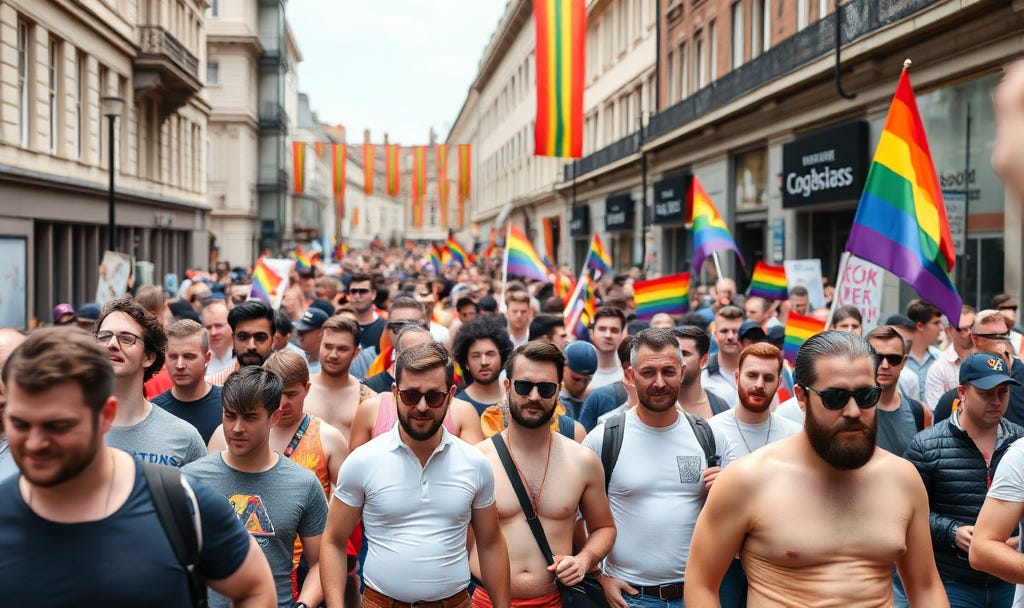
What the Pride season, which is upon us, would suggest is that, post-decriminalisation, being gay has become socially acceptable. I’m not sure that a piece of legislation was necessary for that. Pride marches are a little like wedding cortèges, where a line of young people throwing confetti from open-top sports cars process through the town with their horns blaring and ignoring traffic lights. Everyone else smiles, waves, wishes the happy couple all the best, and then goes back to what they had been doing. But they hope the horns will stop soon. Not every day, thank you.
That’s what gays are now having to come to terms with. We were never really accepted into mainstream society. At best we have been tolerated, but what we did before decriminalisation, we did in private to avoid prosecution; nowadays, we do it in private for exactly the same reason. And there are sadly few others who are enthusiastic to see the public side of homosexuality, whether that’s two men copulating in a wood or a parade down the high street. That is something about which we have deluded ourselves all this time.
Having a gay uncle as my godfather meant I accepted being gay as totally normal as I was growing up. Helped my younger brother too, since he realised he was gay when he was 10. We had holidays with our uncle and his partner, so having two uncles was completely straightforward. Legalising it didn't alter anything so far as we were concerned, since our parents accepted it too!