
What is duty?
What is legality?

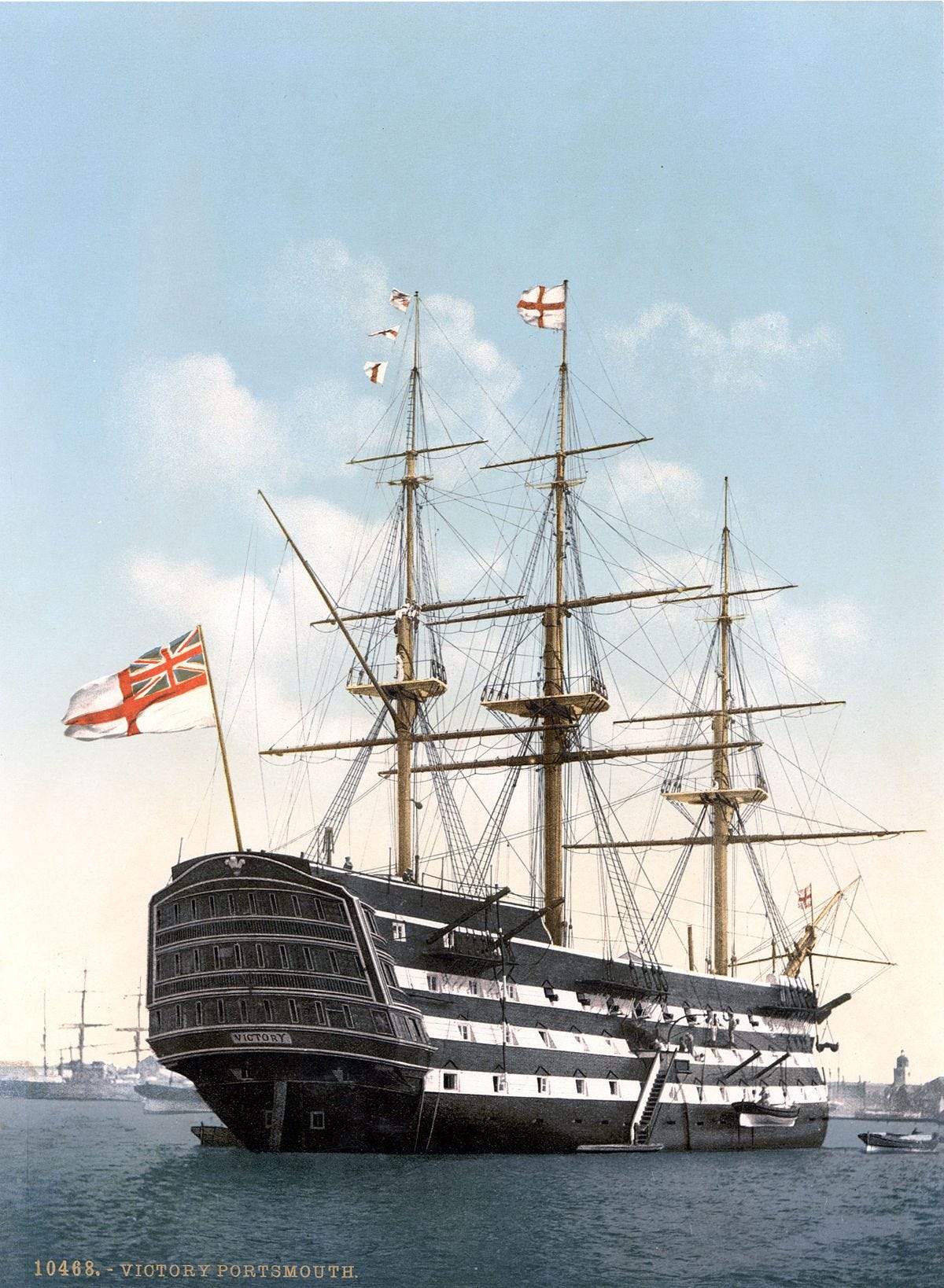
At the Battle of Trafalgar, the British commander, Lord Horatio Nelson, hoisted a semaphore signal to his fleet, reading “England expects that every man will do his duty.” Duty is a word that has no legal definition. But Lord Nelson knew what it meant, and so did his sailors. They won the battle, but Nelson died.
While not a hard-and-fast rule, it’s nonetheless a persuasive element in any argument (whereby the idea of democracy even came about) that, if it can only be enforced at the end of a gun, it is not a good argument. It is not guns themselves that render democracy unworkable. Rather, it is the injudicious application of them to implementing the policy arguments of putatively democratic institutions that is the factor eroding democracy. Like nuclear weapons, we should have guns in order not to use them.
The Bible is a gazetteer, biographical dictionary, a bedtime storybook and, to be frank, just about anything else you want to think of, from the science of winemaking to the hydrological properties of the second-commonest molecule on Earth, but not as it is in Heaven. In there are the two examples upon which I shall dwell awhile. It is authority for the proposition that tax debts require to be discharged. Pay unto Caesar, and all that. The rule (of paying Caesar what’s Caesar’s) is cleverly, and correctly, inferred from Caesar’s appearance on the face of a penny. It is a constant reminder (or was, before the electronic age) of the one party that intrudes into every last transaction, dealing, negotiation, purchase, sale and even theft: the person with their bonce on the penny gets their cut (theft is thereby tax evasion).
The second example is the grant of Israel to the Jewish people by God. Not being a principle but simply a declaration of transfer, it lacks implementation beyond the notion, for want of a probative document. You cannot anywhere transfer land verbally. It must be a written transfer in due and proper form, and it must be registered. And none of Israel’s claim to Israel fulfils that, except it be by documents that the interested party in question has itself prepared, shall we say, for the purposes of the cause. That an argument founded in a biblical scripture gets enforced at the point of a gun makes it a bad argument.
As for taxes, I won’t assert that some people pay them willingly, although some may. Resignedly is probably more applicable. But outright objection to payment of taxes is staunched by a feeling that lies somewhere between powerlessness, recognition of the good that taxes do, and the ability to pay. The national uproar that ensued after Margaret Thatcher introduced the community charge in the UK in the late 1980s arose out of some or all of those governors of outrage: it was the powerlessness of the targeted population (mostly the poor, living in over-crowded circumstances) that galvanised action in their behalf as a single voice. The second, the good that local authority taxes do, by providing street lighting and paved roads as well as, of course, drains—lots of … drains—was not exactly a point at issue in the protests, which were not predicated on the wasteful deployment of ingathered resources by local authorities (unlike the arguments used by DOGE in the US), but rather on the last factor: the ability to pay. People couldn’t. So, they didn’t, and for their troubles some of them landed in prison, under the banner the law is the law and everyone must comply in equal measure (including the member of parliament for Liverpool Broadgreen, under the banner law makers must not be law breakers, a principle that needs a quotation from Neil Kinnock for you to have a good old-fashioned belly laugh at it).
The protests against the community charge (or poll tax as it became known, the basis for taxability no longer being the land register, but rather the electoral register) particularly homed in on that phrase in equal measure. When we pass beneath a street light as it illuminates our way, does the street light consider how much we paid for the assistance it proffers? No, it does not. It illuminates the way for all, high and low, rich and poor, the sinner and pious alike. So, and this was essentially the argument, if a street light illuminates without distinction as to who paid for it, then everyone must pay for it without distinction. That means that the owner of a mansion house pays an equal sum along with each of the eight occupants of a down-at-heel council flat. A mansion house benefits from street lights in no greater measure than does a council flat.
The injustice of that tax rule was finally acknowledged with its repeal, and the community charge in the UK is—for now—gone. Its injustice did not reside especially in its application to a single person regardless of circumstances, however. It resided in the circumstances themselves, changing the question from should a council tenant pay the same rates as the occupant of a mansion house? to how does it come that the occupant of the mansion house even owns the mansion house? The mantra of one man, one vote, which rings sweet and clear in democratic elections, rings a sour note when it comes to fiscal policy, in which the ability to pay performs an Ali-style knock-out. Or used to.
A few years back, I had a minor role in a play by Pieter de Buysscher at the Kaaitheater in Brussels entitled De Lokvogel (or, in English, The Decoy) as The Man Who Wants Two Votes. The character argues that he makes more money on the stock market in a day than some people make in a lifetime, and therefore that, at election time, he should have two votes, as a reflection of his contribution to … whatever it is that he contributes to. The play is a fascinating exploration of the possibilities of multimedia in a live stage event and, at any live stage event, there comes a point when the audience would like to go home. As a result, I feel Pieter’s resolution, which is volunteered by the character himself, to the stand-off he presents in his own mind, is somewhat unrealistic. He says, finally, Ik doe mee. “I’ll go along with things.” Pieter: people who earn in day what I could only aspire to earn in my lifetime never say Ik doe mee. I do wonder whether Pieter would have written the part differently just these five years later. The play would be longer, much longer, because the last act would be a re-write of the story of resistance to the community charge.
The community charge protests in Britain in the years 1988 (when the Labour Party officially began to oppose the tax) to 1992 (its repeal) saw a lot of marches, shouting and police. Britain’s police did not at the time routinely carry weapons beyond their standard-issue truncheons, so it’s not quite in defiance of the point of a gun that this law was refuted. But the community charge in the UK is a very relevant event for the world we are in today because it focuses attention on the viability of protest, on the changes that it can bring about, when voices unify against injustice. Because, then, they succeeded. Would they today?
The rates system that the community charge superseded was not by any account fair. But the government of the day failed to recognise that its alternative was not really any fairer. Governments are actually paid to look into the future. How would you react if you crossed with silver the palm of Madam Zara at the funfair: tell me the future and Madam Zara then says: What? I haven’t got a crystal ball, you know! They may not have balls, crystal or otherwise, but governments have more resources, ways and means to tell the future than I could shake a stick at. And, if these fail, that should be my argument for them to consult more with those who will bear the consequences of that failure.
They say you cannot have your cake and eat it; that you cannot have it both ways; that you can have any colour you want as long as it’s black. That’s what we have in governments across the world: any colour we want as long as it’s black. (There are some shades of grey available, but the result needs careful blending.) Because, regardless of what colour the paint looks like in the tin, and contrary to what people say, power does not corrupt: it entitles. From the viewpoint of the powerful, it does. And entitlement is Henry Ford’s black. A democratic electorate’s challenge lies in recognition of that—the elected’s—viewpoint. You cannot simply argue that corruption is bad, because that is futile. No one, but no one, will contradict that. Certainly, Neil Kinnock never would have done.
What the electorate must do is to ally the assumption of high office with the bearing of responsibility, and no rule book can cater for that. Responsibility—in the law, we call it a duty of care—is something that cannot be regulated in the detail. My goodness, where would be with a rule book that embraced every last judicial tort dictum laid down since Donoghue v. Stevenson?1 No, each case in which liability is cited gets measured against the duty of care that the defender bore: as a passer-by, as a contractual party, as a guardian, as an officer holder under a statutory duty.
Duty is the guiding principle, and in order for it to make any sense, to have purpose and not simply land as one more screwdriver in the toolbox of the politician, it must be divorced from, not allied to, the idea of legality. We live in extraordinary times, so we must start coming up with extraordinary thinking—which, in terms of Project 2025, is in fact what landed us here. Because, if legality is the backbone to the exercise or neglect of duty, what purpose, then, does duty itself have? And, if legality starts to assume a guise that transgresses that finely undefined line that separates a reason from an excuse, then it is no longer even a screwdriver. It is a bludgeon.
Citing legality as the justification for duty or its absence gives the accuser the thankless task of endeavouring to argue—often in vain—about the legality of the legality that is relied upon (such as the law entitles ICE to arrest immigrants which sweeps before it all counterarguments about the manner in which the law was enacted and in which it is being implemented). Now, the United States always was an exception, and I could resignedly accept that, by acquiescing in the proposition that the US’s foreign policy is always, without exception, predicated on the advancement of freedom, human rights and democracy, regardless of how it actually pursues those goals, but I won’t. It is a divine proposition, in the sense that God does not consider what you do, but what you intend to do, and so it is that the US is judged not on what it does, but on what it intends to do, and what it intends to do are … those three things. Ergo?
Last week, I posted a comment on the dire state of justice, generally and in the US in particular, with the following words.
I don’t say this from the luxury of European smugness. When I worked for a law firm in Germany, one close colleague of mine said over lunch one day that we British don’t really understand what Germany went through after the war. The Americans think it was like the film One, Two, Three. It wasn’t. Every time decent Germans came into contact with Allied power citizens, they felt this crushing weight on their conscience. They could but grin and carry on despite the burden of guilt that the post-war generation bore, not for what they had done but for their fathers’ crimes.
It was an eye-opening revelation to me, a Brit, not only from the perspective of the heinous crimes in Nazi Germany, but from the perspective of my own country’s crimes throughout its empire. His shame did not teach me arrogance; it taught me my own shame.
One day, Americans will need to come to terms with the shame and the arrogance of this episode of their country’s history. The arrogance of We told you so. The shame of being unable to help those most desperately in need of help. The powerlessness of a people in whom power—constitutionally—rests.
It garnered one thought-provoking response: an admission of liability. This article is actually my response to that admission, which was phrased thus:
You are exactly CORRECT...we all share this blame...we can’t hide from it...
Leigh Blake, who made the admission, thereby did one thing that can be rare to find these days. She reached beyond the accusation of turpitude as reported, to asking how far she herself might be implicated in the same kind of turpitude. In short, in a discussion between us and them, she admitted that we can also be they. It is the ability to do that that forms the groundwork for building a new juridical future, one in which the inchoate nature of duty takes a central role, and legality is relegated to the task of simply being a chain-link fence on the borders of a property.
Is this a clarion call, akin to We will fight them on the beaches? That’s exactly what this is. Listen, if a law proves itself ineffective in solving the problem its maker intended it to solve, then it must be amended accordingly. But if not a law, rather an entire legal system, can be subjected to the whim of a single head of state who cites legality as his bastion, then amendment will but paper over some pretty wide cracks. Donald Trump’s executive enactments came before the ink was even dry on his verbal solemn promise before God to uphold his country’s constitution. Some argue it is being upheld but, if that is so, we can at least say that it is being upheld in a manner in which it has never been upheld before.
Before. The distinction between upheld and upheld before starts to break down, even if people can point to things happening now that did not previously happen, when tested against legality. If legality were a litmus test, it would turn red in the presence of acidity, blue in an alkaline environment. But it’s not litmus paper. Law can be made to turn acidity blue, instead of red. What ensures, or should ensure, that law doesn’t get used for perverse litmus tests is the factor duty. In the law, you define the colour you want as a result, not the properties of litmus. And it is your duty, or your sense of it, that dictates in how far you should purpose legislation to resolve the mischief and in how far your desired result assumes primordial importance, and thus relegates to details the means you deploy to achieve it—sledgehammer and walnut territory. Duty is what impels you not to crack walnuts with sledgehammers, and from there it is a small step to conclude that duty—nowadays virtually reduced to being an exclusively military term—has a role to play throughout all walks of society.
In 2016, the United Kingdom’s electorate voted to leave the European Union. It was a decision that I played no role in—resident outside the UK, I had no voice in the matter, even though I resided outside the UK precisely as an indirect consequence of the UK’s membership of the European Union. It was a decision of which I both approved and disapproved.
The disapproval was self-evident: it caused red tape problems for me to requalify my foreign residence as citizenship, which brings with it allegiance to the Belgian State. And, in that, I can perhaps provide you with a exemplar par excellence of the entire issue this article deals with, because, for two years, I was undecided on whether to request citizenship, because of one thing: the duty I would be taking upon myself to take up arms in Belgium’s behalf if it so ordered. And no one understood my reservation. For them, citizenship is the passport, to go places. For me, it is the duty that hangs unseen from the back page of that passport, for that, ultimately, is all the government sees when it issues one.
But, why, then, did I approve the vote to leave the EU? What a maelstrom of arguments now enters the arena: we were lied to, the figures were spurious, Johnson was a career liar, it was economic suicide, we were not bound by the result …
Hang on. We were not bound by the result. It was this response from Europhile Brits that quite simply took my breath away. That officials on whose foreheads the word democracy is virtually tattooed contended that it is sometimes necessary to tell the electorate that they got the wrong answer. It is that reaction, rather than one I dreamt up myself, that made me a democrat. Democracy has to be water-tight, but it has to be water-tight osmotically. It must let no water through, whilst letting water through. But leaving a place for water to get through doesn’t give you democracy; it gives you a sinking ship. Democracy isn’t a solution. It’s a method. And, as far as methods go, there are many of them, to skin a cat.
Everyone wants before. But before became now, so do they really want before? There is an old joke. Two men, strangers, sit beside one another in a cinema. On the screen, two cowboys fight it out, and one escapes on a horse and rides off up the hill, over which he will be safe. One of the guys watching leans in to the other and says, “I bet you five pounds that the guy on the horse ends up dead before he gets over the hill.” The other guy looks at him and says, “Five pounds? You’re on!” Lo and behold, the galloping horseman is shot from his saddle. As they leave the movie house, the loser pulls out his wallet and goes to tender a five pound note to the chap who’d made the wager with him. “It’s okay,” says the winner. “I’ve actually seen the film before.” Comes the reply, “To be sure, so have I, but I didn’t think he’d get shot twice.” If you laughed, you understand the joke, but you don’t understand me.
So, let’s suppose you all get your before. Magic wand time, I just waved it. Donald who? Right, well, that was that. Have a nice day.
Oh, while you’re still here, what exactly do you plan doing with your before? What will be different when you get your before to prevent it becoming our now? The answer isn’t easy. First, we know what it won’t be. It will not be reliance on goodwill governance, and even reliance on the rule of law is a sticky area: the rule of law just applies the law, regardless of who makes the rules. And the ultimate arbiter of what they are, the Supreme Court, has ruled that the president can do as he likes. So, eschewing law, and eschewing reliance, what are we left with? Because we must always remember: badwill governance does not act like goodwill governance. That much we know.
This is not the secret to Coca-Cola, or the explanation for Fried Green Tomatoes, or some other important-in-the-moment,-forgotten-ten-minutes-later mystery. They are easy by comparison with this. But I believe that duty is a factor and, if there are to be arguments about what it means, then let it mean what it means to a five-star general and an airman second class alike, without distinction. In legal circles, duty allows itself to be marshalled by the concept of unconscionability. It is applying the idea of what is unconscionable to a duty, whether allied to or absent consideration of the circumstances or exceptional measures or laws, or whatever, that impels one to act or refrain. These are elements that rise above the law. They despise law, in the end. If used wisely, if used honestly, they can just about render law superfluous. It is unconscionability that gets us from a soldier must obey his commander’s orders to a soldier may not obey an order contrary to humanity.
American exceptionalism stands squarely in the path of this line of thinking. So, it must away. If a reset is ever going to be within reach, for both the United States and the rest of the world, the United States needs to be united with the rest of the world: for the very simple reason of convergence by divergence. The rest of the world is converging on the American standpoint by yearning for America’s exceptionalism. And that is splitting us up. They can’t have it, not if there’s to be a world to which to be an exception.
Ice cream sells well when the temperature goes up. But after a certain temperature, sales of ice cream slacken off. The problem is customers’ fear that the ice cream will be melted before they get it home. The same dynamic applies to agreeing with American exceptionalism. You can agree, but if they take it too far, life is too short for us all to agree to agree. At that point, we must disagree, with America. Let me explain.
God interrogates intention by means of the human conscience. You cannot argue with God that you didn’t really intend something. He knows. But the US’s intentions are its intentions because it says so, which is a manifest loophole for abuse, which they deny, of course, at which point one simply acquiesces, if only because life is too short. There comes a point, however, at which life is too short to acquiesce.
Exceptionalism is impunity, is entitlement, is why the hell shouldn’t I? Exceptionalism is (sorry) fuck you, and if I ever allowed myself to believe my purpose in this life is to tell humanity fuck you, then take me from it now, this instant.
A soldier tempers his orders by appealing to his humanity. That’s not in King’s Regulations. It’s in international law, but most of all, it’s in his heart. The answer lies in duty, marshalled by conscience, tram-lined by unconscionability, and approved by them upon whom the duty is incumbent. Getting government from here, wherever here is for you, to that prospect of government with conscience, may seem to you a long way. But it’s no longer than that from obeying orders to not flouting our sense of humanity.
A caveat: if this is an argument that appeals, then it must not be driven home at the point of a gun. If we do that, then it will have been a bad argument.
Flashback:
[1932] AC 562.
Very complex, indeed. I think each of us has our own concept of duty, and it is probably different from others concept, so no matter how we describe it, many others will disagree.